


Page 11 - PEN_Ebook_October2021
P. 11
ENERGY                                                                                              Energy


            Thus, in light of the latest Intergovernmental Panel on Climate Change (IPCC) report showing that
            greenhouse gas emissions from human activities are responsible for approximately 1.1°C of warming
            since 1850–1900, and using estimates averaged for the next 20 years, then global temperature is

            expected to reach or exceed 1.5°C of warming, with a dramatic impact on climate and society. It is
            clearly important to accelerate the transition toward “clean hydrogen.”


            If all of the current dedicated hydrogen production (70 million metric tons) was from water electrolysis
            (using water and electricity to create hydrogen), this would result in an annual electricity demand
            of 3,600 TWh, which is more than the electricity produced by the European Union per year. The
            amount of water required to produce hydrogen from electrolysis would be equivalent to 617 million
            cubic meters, which is roughly twice the current water consumption for hydrogen produced from
            natural gas. Also, the amount of renewable energy available to produce hydrogen remains marginal

            and is limited to small-scale applications. The challenge is huge, and that’s what engineers love.


 The Amazing World of


 Green Hydrogen


 By Patrick Le Fèvre, chief marketing and communication officer at PRBX


 For over 100 years, hydrogen (H ) has been considered a potential source of clean energy and,
 2
 as presented in the July PEN eBook article “European Green Deal: Green Hydrogen Becomes a
 Reality,” it’s getting a serious boost from international initiatives to reduce carbon emissions and
 the European Union goal to produce 100% carbon-free energy by 2050.


 We should keep in mind that as of today, less than 2% of the global production is coming from

 electrolyzers, and a small portion comes from recycling energy. At a time when a number of new
 applications — other than the industrial and chemical industries — are expected to use hydrogen
 as a propellant or alternative energy storage solution, it is perhaps pertinent to take an overview of
 the situation and what to expect in the coming years.


 CAN WE GO 100% GREEN HYDROGEN TODAY?
 It is estimated that worldwide hydrogen production is about 70 million metric tons and mainly

 produced from natural gas (75%) and coal (23%). To produce that amount of hydrogen, consumption
 levels of 205 billion cubic meters of natural gas (6% of the global use) and 107 metric tons of coal (2%
 of the global use) are needed. Based on existing production methods, global hydrogen production
 is responsible for 830 metric tons of CO  per year. Producing hydrogen from fossil energy without
 2
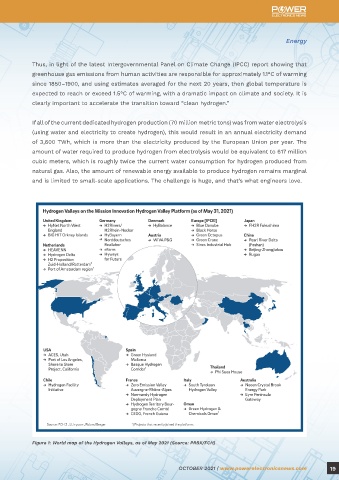
 capturing the CO  emitted during production is the cheapest method ($1/kgH ).  Figure 1: World map of the Hydrogen Valleys, as of May 2021 (Source: PRBX/FCH)
 2  2


 18  OCTOBER 2021 | www.powerelectronicsnews.com                OCTOBER 2021 | www.powerelectronicsnews.com          19

