


Page 21 - PEN Ebook March 2021
P. 21
Semiconductors                                                                               Semiconductors


          needed to properly turn the transistor off. There    THE IMPACT OF ALTERNATE

          is also a difference in the drive required for the   CURRENT PATHS
          steady on-state and during off-/on-transients.       Even with separate drive circuitry for each tran-
                                                               sistor, there is still a shared current path in the
          The circuit in figure 1 resolves this. A low-imped-  gate driver loops (Figure 2) as, inevitably, some
          ance fast AC-path through R  turns the device        current flows through the Kelvin source. Even tiny
                                     on
          on, while R  determines the steady-state diode       millivolt differences can result in severe oscilla-
                    SS
          current. When turning the transistor off, a nega-    tions between the two transistors.
          tive gate voltage, V , is required. This is achieved
                            G
 Figure 1: E-mode GaN HEMT equivalent circuit (left) and proposed driving scheme (right).  by ensuring C  is larger than C .  A high-impedance common-mode (CM) inductor
                                        GS
                       on
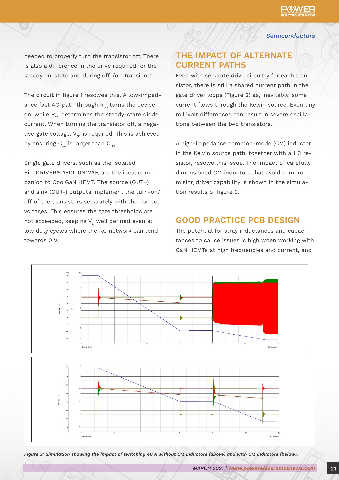
                                                               in the Kelvin source path, together with a 1 Ω re-
          Single gate drivers, such as the isolated            sistor, resolve this issue. The impact of carefully
          EiceDRIVER™ 1EDI20N12AF, are the ideal com-          dimensioned CM inductors that avoid compro-
          panion to CoolGaN HEMT. The source (OUT+)            mising driver capability is shown in the simula-
          and sink (OUT-) outputs implement the turn-on/       tion results of figure 3.
          off of the transistors separately with the correct
          voltages. This ensures the gate thresholds are

          not exceeded, keeping V  well defined even at        GOOD PRACTICE PCB DESIGN
                                 G
          low duty cycles where the RC network can tend        The potential for stray inductances and capaci-
          towards 0 V.                                         tances to cause issues is high when working with
                                                               GaN HEMTs at high frequencies and current, and


 Figure 2: In parallel CoolGaN™ operation, a high impedance in the Kelvin source path keeps severe oscillations in check.


          Figure 3: Simulation showing the impact of switching 40 A without CM inductors (above) and with CM inductors (below).

 20  MARCH 2021 | www.powerelectronicsnews.com                       MARCH 2021 | www.powerelectronicsnews.com       21

