


Page 5 - EE Times Europe Magazine - June 2025
P. 5
EE|Times EUROPE   5


         MARKET RESEARCH | SILICON AMBITIONS
        How Egypt, Saudi Arabia, and Oman Are Building


        the Middle East’s Chip Future


        By Mohammed Tmimi

          n the past few years, the semiconductor industry has been thrust into the spotlight as geopolitical tensions, global
          supply chain disruptions, and the race for technological dominance have revealed just how crucial—and vulnerable—the
          semiconductor supply chain really is. Today, governments around the world see semiconductors not just as a business
       Iopportunity but as a matter of economic independence and national security.

          For countries in the Middle East, this wake-up call has sparked   Its strategy rests on two pillars:
        something bigger. A new chapter is unfolding in which building local   ·   An Innovation Pillar supports local fabless semiconductor startups,
        chip ecosystems isn’t just a policy goal but a bet on the future.  fostering innovation and product development.
          In Saudi Arabia and Oman, building a local semiconductor industry   ·  A Manufacturing Pillar encourages labor-intensive electronics
        is part of a bigger plan to reduce their economies’ dependence on oil   manufacturing to create job opportunities. Egypt now hosts major
        revenues and create high-tech industries that can drive future growth.   manufacturing operations from global giants such as Samsung and
        These countries are thinking long-term, investing in talent, infra-  LG, as well as homegrown industry leaders such as Elsewedy (smart
        structure, and partnerships to develop homegrown capabilities in chip   meters) and Elaraby (consumer electronics).
        design and manufacturing.                               Egypt’s semiconductor strategy deliberately avoids the high costs
          Egypt, for its part, is not starting from scratch. The country has a   associated with building semiconductor fabs by focusing instead on
        long history in microelectronics and semiconductor design, with a   the strategic strength of design and system integration until the local
        strong base of engineers, research centers, and startups already active   ecosystem is robust enough to justify larger-scale investments.
        in the space. Egypt is now looking to scale up by attracting investment,
        expanding its ecosystem, and cementing its position as a regional   Global companies bet on Egyptian talent
        design hub.                                           The strong local talent pool, particularly in electrical engineering and
          This article takes a closer look at how Egypt, Saudi Arabia, and Oman   embedded systems, has not gone unnoticed by international com-
        are stepping into the semiconductor spotlight. It covers their recent   panies. Over the past decade, global tech giants have opened design
        initiatives, investments, and collaborations over the past three years to   centers in Egypt for IC and IP development, integrating Cairo into their
        show how each country is building its own path in this critical industry.  global design networks:
                                                                ·  STMicroelectronics established a large R&D center in Maadi Tech
        EGYPT: A RISING HUB FOR SEMICONDUCTOR                    Park, focusing on digital and microcontroller designs.
        INNOVATION AND DESIGN                                   ·  Goodix Technology, a major Chinese chip designer, opened a Cairo
        Egypt has steadily built one of the most vibrant semiconductor ecosys-  office to work on IoT and automotive semiconductor solutions.
        tems in the Middle East and North Africa region, though that success   ·  MediaTek, one of the world’s top fabless companies, recently
        didn’t happen overnight. The effort got underway nearly 20 years ago   opened a design center in Cairo, reinforcing Egypt’s role in global
        when Hisham Haddara, a former executive at Memscap and Mentor   chip design.
        Graphics, cofounded Si-Ware Systems, Egypt’s
        first fabless semiconductor company. At the
        time, the idea of designing advanced chips in
        Cairo sounded ambitious, if not unrealistic.
        But that bold move planted the seed for what
        would become a thriving ecosystem built
        around Egyptian engineering talent and a
        long-term vision for global competitiveness.
          Egypt’s reputation in chip design has grown
        steadily, attracting the attention of global
        players and inspiring a new generation of
        local semiconductor entrepreneurs.

        National strategy to scale up
        ‘Egypt Makes Electronics’
        The Egyptian government launched the
        “Egypt Makes Electronics” (EME) initiative in
        2016 through the Ministry of
        Communication and Information Technology.
        Updated in recent years as EME 2.0, this strat-
        egy laid the foundation for scaling Egypt’s
        electronics and semiconductor sectors.
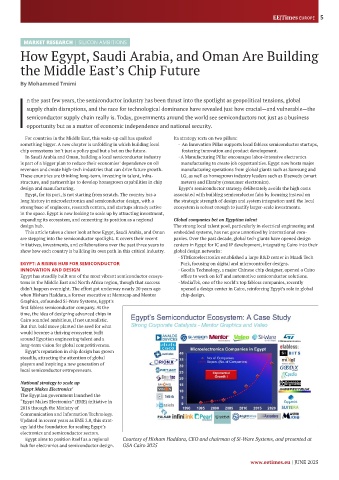
          Egypt aims to position itself as a regional   Courtesy of Hisham Haddara, CEO and chairman of Si-Ware Systems, and presented at
        hub for electronics and semiconductor design.   GSA Cairo 2025


                                                                                         www.eetimes.eu | JUNE 2025

