


Page 40 - EE Times Europe Magazine - June 2025
P. 40
40 EE|Times EUROPE

        Imec’s Vision for Automotive Over the Long Haul


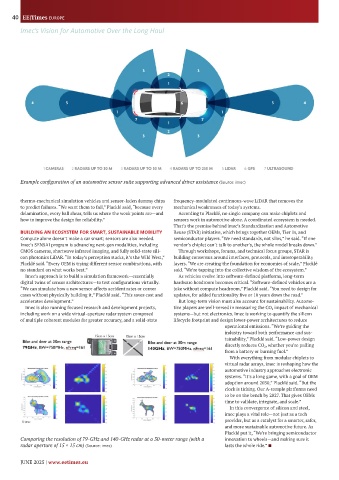
        Example configuration of an automotive sensor suite supporting advanced driver assistance (Source: imec)


        thermo-mechanical simulation vehicles and sensor-laden dummy chips   frequency-modulated continuous-wave LiDAR that removes the
        to predict failures. “We want them to fail,” Placklé said, “because every   mechanical weaknesses of today’s systems.
        delamination, every ball shear, tells us where the weak points are—and   According to Placklé, no single company can make chiplets and
        how to improve the design for reliability.”           sensors work in automotive alone. A coordinated ecosystem is needed.
                                                              That’s the premise behind imec’s Standardization and Automotive
        BUILDING AN ECOSYSTEM FOR SMART, SUSTAINABLE MOBILITY  Reuse (STAR) initiative, which brings together OEMs, Tier 1s, and
        Compute alone doesn’t make a car smart; sensors are also needed.   semiconductor players. “We need standards, not silos,” he said. “If one
        Imec’s SENSAI program is advancing next-gen modalities, including   vendor’s chiplet can’t talk to another’s, the whole model breaks down.”
        CMOS cameras, shortwave infrared imaging, and fully solid-state sili-  Through workshops, forums, and technical focus groups, STAR is
        con photonics LiDAR. “In today’s perception stacks, it’s the Wild West,”   building consensus around interfaces, protocols, and interoperability
        Placklé said. “Every OEM is trying different sensor combinations, with   layers. “We are creating the foundation for economies of scale,” Placklé
        no standard on what works best.”                      said. “We’re tapping into the collective wisdom of the ecosystem.”
          Imec’s approach is to build a simulation framework—essentially   As vehicles evolve into software-defined platforms, long-term
        digital twins of sensor architectures—to test configurations virtually.   hardware headroom becomes critical. “Software-defined vehicles are a
        “We can simulate how a new sensor affects accident rates or corner   joke without compute headroom,” Placklé said. “You need to design for
        cases without physically building it,” Placklé said. “This saves cost and   updates, for added functionality five or 10 years down the road.”
        accelerates development.”                               But long-term vision must also account for sustainability. Automo-
          Imec is also running focused research and development projects,   tive players are well-versed in measuring the CO 2  impact of mechanical
        including work on a wide virtual-aperture radar system composed   systems—but not electronics. Imec is working to quantify the silicon
        of multiple coherent modules for greater accuracy, and a solid-state   lifecycle footprint and design lower-power architectures to reduce
                                                                                operational emissions. “We’re guiding the
                                                                                industry toward both performance and sus-
                                                                                tainability,” Placklé said. “Low-power design
                                                                                directly reduces CO 2 , whether you’re pulling
                                                                                from a battery or burning fuel.”
                                                                                  With everything from modular chiplets to
                                                                                virtual radar arrays, imec is reshaping how the
                                                                                automotive industry approaches electronic
                                                                                systems. “It’s a long game, with a goal of OEM
                                                                                adoption around 2030,” Placklé said. “But the
                                                                                clock is ticking. Our A-sample platforms need
                                                                                to be on the bench by 2027. That gives OEMs
                                                                                time to validate, integrate, and scale.”
                                                                                  In this convergence of silicon and steel,
                                                                                imec plays a vital role—not just as a tech
                                                                                provider, but as a catalyst for a smarter, safer,
                                                                                and more sustainable automotive future. As
                                                                                Placklé put it, “We’re bringing semiconductor
        Comparing the resolution of 79-GHz and 140-GHz radar at a 30-meter range (with a   innovation to wheels—and making sure it
        radar aperture of 15 × 15 cm) (Source: imec)                            lasts the whole ride.” ■

        JUNE 2025 | www.eetimes.eu

