


Page 6 - 23_EETE_03
P. 6
6 EE|Times EUROPE


          COVER STORY
        Contactless Measurement


        of Vital Signs with Radar


        Sensors


        BY BERND HETTICH, Product Marketing Manager, Infineon Technologies, and SHUAI JIANG, Master’s
        Student, Technical University of Munich

        The use of radar for monitoring vital signs has been researched for decades. The
        technology enables continuous contactless monitoring of heart and respiration rate
        while having low power consumption and a small PCB footprint. With innovative
        60-GHz radar sensors, its use in consumer electronics is now becoming a reality.


          n an aging society, health monitoring plays   their children and infants are doing well so   The most important vital signs that can
          an increasingly important role. It is better   that they can react quickly if the worst should   be monitored include heartbeat and respi-
          to detect health problems at an earlier   happen.                     ration rate. This information can be used to
       Istage, thus avoiding hospital stays or at   Many diseases can be detected early based   detect diseases like cardiovascular disease
                                                                                                              2
        least shortening them as much as possible.   on irregularities in cardiopulmonary data.   or chronic obstructive pulmonary disease
        People want to live a self-determined and   New possibilities are emerging thanks to   (COPD)  at an early stage. Similarly, diseases
                                                                                     3
        independent life in their familiar surround-  advances in technology. Since smartwatches   like sleep apnea can be detected through
        ings into old age.                  were first launched, the combination of   sleep monitoring.
          In addition, young people are interested   consumer electronics with digital health mon-  Most technologies used today for tracking
        in more personalized and self-determined   itoring has become increasingly popular. This   and monitoring require direct contact with the
        medical services. With the ability to monitor   positive trend is also evident in the healthcare   patient via such means as electrodes or skin
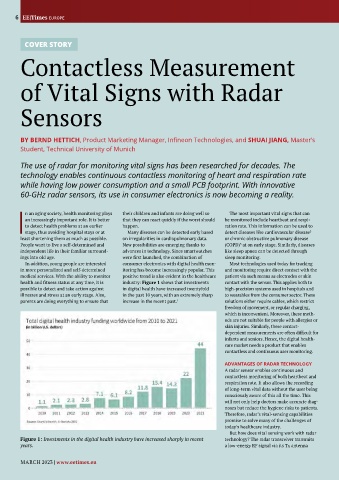
        health and fitness status at any time, it is   industry: Figure 1 shows that investments   contact with the sensor. This applies both to
        possible to detect and take action against   in digital health have increased twentyfold   high-precision systems used in hospitals and
        illnesses and stress at an early stage. Also,   in the past 10 years, with an extremely sharp   to wearables from the consumer sector. These
        parents are doing everything to ensure that   increase in the recent past. 1  solutions either require cables, which restrict
                                                                                freedom of movement, or regular charging,
                                                                                which is inconvenient. Moreover, these meth-
                                                                                ods are not suitable for people with allergies or
                                                                                skin injuries. Similarly, these contact-
                                                                                dependent measurements are often difficult for
                                                                                infants and seniors. Hence, the digital health-
                                                                                care market needs a product that enables
                                                                                contactless and continuous user monitoring.

                                                                                ADVANTAGES OF RADAR TECHNOLOGY
                                                                                A radar sensor enables continuous and
                                                                                contactless monitoring of both heartbeat and
                                                                                respiration rate. It also allows the recording
                                                                                of long-term vital data without the user being
                                                                                consciously aware of this all the time. This
                                                                                will not only help doctors make accurate diag-
                                                                                noses but reduce the hygiene risks to patients.
                                                                                Therefore, radar’s vital-sensing capabilities
                                                                                promise to solve many of the challenges of
                                                                                today’s healthcare industry.
                                                                                  But how does vital sensing work with radar
        Figure 1: Investments in the digital health industry have increased sharply in recent   technology? The radar transceiver transmits
        years.                                                                  a low-energy RF signal via its Tx antenna

        MARCH 2023 | www.eetimes.eu

