


Page 28 - EE Times Europe March 2022
P. 28
28 EE|Times EUROPE

                                                                                                                                      Nuclear Fusion Research Looks to Secure the Future of Energy
            POWERING THE FUTURE
           Nuclear Fusion Research Looks to Secure

           the Future of Energy


           By Maurizio Di Paolo Emilio


                  lobal power demand is expected to   are close enough to each other in the plasma   However, the extremely high heat (and,
                  double by 2040 and could increase   state (the so-called fourth state of matter).  hence, energy) required to heat a
                  fivefold by 2060 as electrification   Isotopes of a given element vary according   hydrogen-containing gas would pull an elec-
          Gexpands to new applications. One    to the number of neutrons. The nucleus of a   tron off its nucleus, leaving it with only its
           solution for meeting that demand, currently   hydrogen atom is created by a single proton,   positive charge (ionization). Furthermore, at
           being pursued by researchers around the   and hydrogen isotopes differ depending on   these temperatures, the hydrogen gas would
           globe, is to build nuclear-fusion power plants   the other particles: Deuterium has a nucleus   have two separate currents — one negative,
           capable of supplying grid-scale electricity   with one proton and one neutron, tritium has   from the electrons torn from the nucleus,
           with zero emissions of climate-altering gases.   two neutrons, hydrogen-4 has three neutrons,   and the other positive, from the surviving
             The technology would replicate the pro-  and so on.                   protons — and the gas would become a
           cesses of the sun, which has been releasing a   In the transfer of mass into energy,    plasma. Magnetic fields would affect the
           tremendous amount of energy for millions of   nuclear-fusion reactions use Einstein’s ratio:   currents created at this location. Only a
           years by converting matter through nuclear   E = mc . Positively charged nuclei will tend to   magnetic field would be able to capture and
                                                   2
           fusion, including the transition of hydrogen   repel each other, so the hydrogen nuclei must   confine the plasma in its coils, keeping it
           isotopes into helium atoms. Everything in   be able to approach very close to other hydro-  away from the containment walls.
           nature, as we all know, tends to a condition of   gen nuclei that still have protons in order to   A magnetic confinement reactor called a
           the least potential energy, and we all tend to   achieve the fusion goal. This allows nuclear   tokamak uses a toroidal (doughnut-shaped)
           the ideal state of rest. An item held 1 meter   forces to bind them together, resulting in a   container structure. While substantial energy
           from the ground will fall to the ground if   heavier particle.          will be needed to create the plasma and
           released; i.e., it will gravitate to a state of                         keep it contained, the energy generated by
           minimal potential energy — in this instance,   TEMPERATURE AND PLASMA   nuclear fusion exceeds the energy expended
           gravitational energy.               High-temperature heat thermally agitates   to get it. The gain factor is the proportion of
             Although potential energy at the atomic   particles, and the resultant disordered motion   energy gained versus energy wasted (Q). It’s
           level has a different nature, everything works   could help them bind. If they are positively   also important that the plasma remain stable
           in a similar way. In the fusion reaction, the   charged, they will repel each other, so it will   — i.e., contained — for an extended period.
           nuclei of two isotopes fuse so that they both   be necessary to reach a temperature of at   Temperature and confinement duration are
           go to a lower energy state, releasing the   least 100 million degrees Celsius for fusion   critical criteria for demonstrating nuclear   IMAGE: SHUTTERSTOCK
           excess energy. However, the fusion reaction   to occur. Such high temperatures are difficult   fusion’s potential.
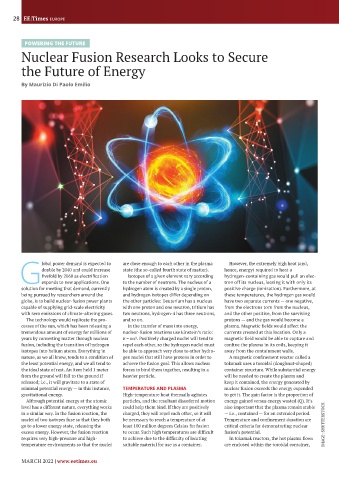
           requires very high-pressure and high-   to achieve due to the difficulty of locating   In tokamak reactors, the hot plasma flows
           temperature environments so that the nuclei   suitable material for use as a container.  are enclosed within the toroidal container,

           MARCH 2022 | www.eetimes.eu

