


Page 9 - EE Times Europe Magazine | April2019
P. 9
EE|Times EUROPE   9


         SPECIAL REPORT: AUGMENTED/VIRTUAL/MIXED REALITY
        Kemet’s CTO Talks Virtual Reality


        By Gina Roos


              emet Corp. was acquired by Yageo Corp. in 2019, transforming   eccentric rotating mass (ERM) motors and linear resonant actuators
              the companies into a US$3 billion interconnect, passive, and   (LRAs), with more recent developments around piezoelectric actuators
              electromechanical powerhouse in the electronics industry.   and drivers.
       KThe electronic components manufacturer, which celebrated its   Thanks to the NEC TOKIN acquisition, Kemet already had entry into
        100th anniversary last year, has been expanding its product portfolio   the piezoelectric market. In 2016, Kemet began a collaboration with
        over the past several years in order to grow and innovate for next-   Novasentis Inc., a developer of haptic and sensory feedback technology
        generation technologies.                              for wearable devices. Kemet acquired Novasentis in July 2019. The two
          Historically, Kemet has been known as a major capacitor manufac-  companies are working to develop and commercialize electromechani-
        turer for high-reliability applications, such as automotive, medical,   cal polymer (EMP)-based haptic actuators for wearable and VR devices.
        military and aerospace, industrial, and telecom. But in recent years, the   The collaboration leveraged Novasentis’s haptic actuator film and
        emergence of technologies such as IoT, 5G, automotive electrification,   core technology and Kemet’s expertise in film-based capacitor manu-
        wearables, and AR/VR has led the company to expand beyond passive   facturing. The film-based haptic actuators offer an ultra-thin profile
        components to play a bigger role in these growing markets and to   and small size for haptic feedback in VR and wearable applications,
        continue on a growth path.                            providing a variety of tactile sensations.
          In order to enhance its market position, Kemet needed to develop   The thin, flexible actuators deliver piezoelectric effects at lower
        new technologies and products. The company’s move into new com-  operating voltages compared with traditional piezoelectrics. They can
        ponent segments started in 2013 with its alliance with NEC TOKIN. It   also produce audible sound when they vibrate in response to audio
        acquired the company outright in 2017, gaining entry into a range of   signals, similar to speakers, simultaneously providing haptic and audio
        new products and solutions, including temperature sensors, current   feedback. With the Novasentis LiveTouch haptic skin technology,
        sensors, piezoelectric actuators, current transformers, inductors, filters,   designers can add touch to the surface of products, providing localized
        and supercapacitors.                                  and natural authentic touch sensations, as well as programmable and
          One emerging technology that Kemet had its eye on was haptics,   customizable effects for a range of sensations.
        or tactile feedback, which improves the user’s touch experience on all   In an interview with EE Times Europe sister publication Electronic
        kinds of devices, from smartphones to headsets. With the addition of   Products, Philip Lessner, Ph.D., Kemet’s senior vice president and CTO,
        haptics and some software, OEM designers can create a different user   said that he is starting to see real-world uses for VR in industrial set-
        experience while differentiating their products.      tings, including Kemet’s factory locations, where VR is helping to train
          Traditionally, the two key technologies used for haptic actuators are   workers on complex equipment. Excerpts appear below.


        ELECTRONIC PRODUCTS: What are the   EP: What differentiates Novasentis’s   for 25-V and 35-V parts for the input power,
        basic building blocks, at the component   haptic technology from competitors?  similar to what you would see in high-end
        level, for AR/VR devices?           Lessner: Most haptics are done via an   laptop computers. Apple, is, of course, a big
        Philip Lessner: I’ll talk primarily about the   electromagnetic coil or something similar, so   user of polymer tantalum for the MacBooks.
        two technologies that we have. One building   they’re fairly bulky and intrusive. We have a   It’s about getting the most capacitance into
        block for these very advanced computers is   polymer film that when you apply a voltage   the smallest constrained space as possible.
        coming up with the lightest power-   signal to it, it vibrates and provides that
        conversion components. It really means   haptics experience. How we’re differentiated   EP: In terms of sensors — the second
                          capacitors, and   from traditional devices are the advantages   building block that you offer — do
                          in our case, it’s   of miniaturization and better integration into   you think that sensors, in general, are
                          polymer tantalum   end products like a glove or vest.  the biggest area of innovation for VR
                          capacitors.         The original work for the polymer film   applications?
                            So it’s the     came out of Pennsylvania State University.   Lessner: Yes, I think [they] will be. In
                          portability and   Novasentis bought the patent, along with   general, you need a lot of sensors on these
                          wearability aspect    other add-on patents after that. We don’t   devices, and of course, a lot of them take
                          of it — provid-   believe anybody else in the world can make a   advantage of the sensors that have been
                          ing high-power    device quite like this.             incorporated into smartphones and other
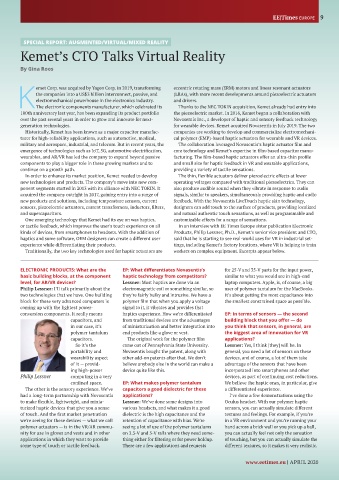
        Philip Lessner    computing in a very                                   devices, as part of continuing cost reductions.
                          confined space.   EP: What makes polymer tantalum     We believe the haptic ones, in particular, give
          The other is the sensory experience. We’ve   capacitors a good dielectric for these   a differentiated experience.
        had a long-term partnership with Novasentis   applications?               I’ve done a few demonstrations using the
        to make flexible, lightweight, and minia-  Lessner: We’ve done some designs into   Oculus headset. With our polymer haptic
        turized haptic devices that give you a sense   various headsets, and what makes it a good   sensors, you can actually simulate different
        of touch. And the first market penetration   dielectric is the high capacitance and the   textures and feelings. For example, if you’re
        we’re seeing for these devices — what we call   retention of capacitance with bias. We’re   in a VR environment and you’re running your
        polymer actuators — is in the VR/AR commu-  seeing a lot of use of the polymer tantalums   hand across a brick wall or you pick up a ball,
        nity for use in gloves and vests and in other   on 3.3-V and 5-V rails where they need some-  you can actually feel not only the sensation
        applications in which they want to provide   thing either for filtering or for power holdup.   of touching, but you can actually simulate the
        some type of touch or tactile feedback.  There are a few applications and requests   different textures, so it makes it very realistic.

                                                                                       www.eetimes.eu | APRIL 2020

