


Page 36 - PEN eBook February 2024
P. 36
DESIGN                                                                                                                                                                                                                 DESIGN


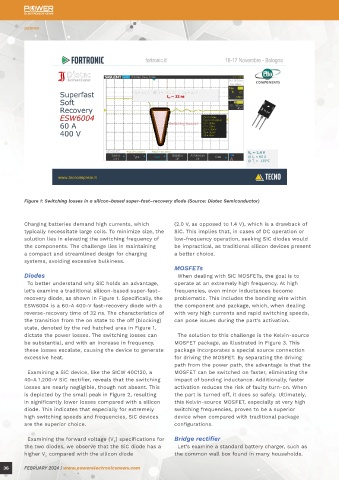
          Figure 1: Switching losses in a silicon-based super-fast–recovery diode (Source: Diotec Semiconductor)                 Figure 2: Switching losses in a SiC-based diode (Source: Diotec Semiconductor)


          Charging batteries demand high currents, which      (2.0 V, as opposed to 1.4 V), which is a drawback of               Although the wall box is nominally rated at 3 kW,   recalculating, the overall power losses in the bridge
          typically necessitate large coils. To minimize size, the   SiC. This implies that, in cases of DC operation or         the typical power consumption is 1 kW. A key        are reduced to 6.7 W. Considering the widespread use
          solution lies in elevating the switching frequency of   low-frequency operation, seeking SiC diodes would              component of the wall box is the bridge rectifier.   of such wall boxes in our homes, the total available
          the components. The challenge lies in maintaining   be impractical, as traditional silicon devices present             When using a GBU10K component in a 1-kW charger,    market is currently about 120 million units. Assuming
          a compact and streamlined design for charging       a better choice.                                                   it draws approximately 4 A from the mains. With a   that 10% of these wall boxes are equipped with the
          systems, avoiding excessive bulkiness.                                                                                 voltage drop of 0.98 V per diode and only two diodes   new low-power bridge rectifier, our calculations
                                                              MOSFETs                                                            conducting per half-wave, calculations show a power   reveal potential energy savings of approximately
          Diodes                                               When dealing with SiC MOSFETs, the goal is to                     loss of 7.8 W in the bridge.                        58 million kilowatt-hours worldwide, simply by
           To better understand why SiC holds an advantage,   operate at an extremely high frequency. At high                                                                        adopting a different bridge rectifier. This is quite an
          let’s examine a traditional silicon-based super-fast–  frequencies, even minor inductances become                       Diotec has introduced a new bridge rectifier, the   impressive result, and we are just talking about a
          recovery diode, as shown in Figure 1. Specifically, the   problematic. This includes the bonding wire within           GBU10K-LV, featuring a lower V  of 0.87 V. After    single rectifier bridge.
                                                                                                                                                             F
          ESW6004 is a 60-A 400-V fast-recovery diode with a   the component and package, which, when dealing
          reverse-recovery time of 32 ns. The characteristics of   with very high currents and rapid switching speeds,
          the transition from the on state to the off (blocking)   can pose issues during the part’s activation.
          state, denoted by the red hatched area in Figure 1,
          dictate the power losses. The switching losses can   The solution to this challenge is the Kelvin-source
          be substantial, and with an increase in frequency,   MOSFET package, as illustrated in Figure 3. This
          these losses escalate, causing the device to generate   package incorporates a special source connection
          excessive heat.                                     for driving the MOSFET. By separating the driving
                                                              path from the power path, the advantage is that the
           Examining a SiC device, like the SICW 40C120, a    MOSFET can be switched on faster, eliminating the
          40-A 1,200-V SiC rectifier, reveals that the switching   impact of bonding inductance. Additionally, faster
          losses are nearly negligible, though not absent. This   activation reduces the risk of faulty turn-on. When
          is depicted by the small peak in Figure 2, resulting   the part is turned off, it does so safely. Ultimately,
          in significantly lower losses compared with a silicon   this Kelvin-source MOSFET, especially at very high
          diode. This indicates that especially for extremely   switching frequencies, proves to be a superior
          high switching speeds and frequencies, SiC devices   device when compared with traditional package
          are the superior choice.                            configurations.

           Examining the forward voltage (V ) specifications for   Bridge rectifier
                                         F
          the two diodes, we observe that the SiC diode has a   Let’s examine a standard battery charger, such as
          higher V  compared with the silicon diode           the common wall box found in many households.
                 F
  36      FEBRUARY 2024 | www.powerelectronicsnews.com                                                                                                                                        FEBRUARY 2024 | www.powerelectronicsnews.com  37

