


Page 8 - PEN eBook October 2022
P. 8
Cover Story — Design                                                                                                                                                                            Cover Story — Design


            FLEXIBILITY AND CONFIGURABILITY IN A HIGHLY INTEGRATED                                                                 The POSIF module performs time measurements between sensor event readings, error handling,

            SOLUTION                                                                                                               and synchronization with the PWM generation modules. This enhanced functionality allows the
                                                                                                                                   CPU to run other tasks without having to implement specific firmware routines to enable these

                                                                                                                                   readings, actions, and calculations. While it is a relatively simple implementation, there are some
                                                                                                                                   disadvantages to a scheme that includes sensors, such as the increased cost of the sensors, the
                                                                                                                                   high torque ripple, and the lower reliability (mechanical connectors and cables are coming out of
                                                                                                                                   the motor).


                                                                                                                                   SENSORLESS MOTOR CONTROL APPLICATIONS
                                                                                                                                   In  order  to  overcome  some  of  the  limitations  in  applications  that  require  sensors,  sensorless
                                                                                                                                   techniques can be implemented. One method operates by reading the back electromotive force
                                                                                                                                   (back EMF) of the motor’s windings. Another solution is a control scheme called field-oriented

                                                                                                                                   control (FOC). Some of the advantages of this implementation are described as follows:


                                                                                                                                     ▶   Rotor position detection sensors are not required; a software estimator is used to calculate
                                                                                                                                       rotor position and speed.
                                                                                                                                     ▶   The torque ripple is lower (compared with trapezoidal control), which translates into lower
                                                                                                                                       power losses and audible noise reduction.
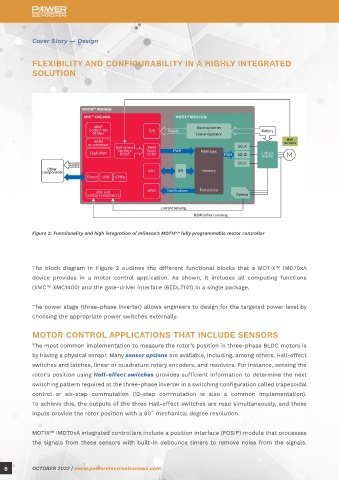
            Figure 2: Functionality and high integration of Infineon’s MOTIX™ fully programmable motor controller
                                                                                                                                     ▶   Better torque control compared with trapezoidal control.

                                                                                                                                     ▶   Efficiency is higher throughout the speed range.
                                                                                                                                     ▶   High-resolution rotor angle/speed detection.
            The  block  diagram  in  Figure  2  outlines the  different functional  blocks that  a  MOTIX™  IMD70xA                  ▶   Good dynamic load change response.
            device provides in a motor control application.  As shown, it includes all computing  functions
            (XMC™ XMC1400) and the gate-driver interface (6EDL7141) in a single package.                                           On  the  other  hand,  one  of  the  disadvantages  of  the  FOC  control  scheme  is  its  complexity;
                                                                                                                                   consequently,  the  CPU  requires  more  computing  power.  IMD70xA  integrated  controllers
            The power stage (three-phase inverter) allows engineers to design for the targeted power level by                      include  several  peripherals  that  facilitate  the  implementation  of  FOC,  such  as  a  MATH
            choosing the appropriate power switches externally.                                                                    co-processor to perform calculations required in sensorless FOC algorithms to enable higher system
                                                                                                                                   performance:
            MOTOR CONTROL APPLICATIONS THAT INCLUDE SENSORS

            The most common implementation to measure the rotor’s position in three-phase BLDC motors is                             ▶   MATH co-processor running at 96 MHz featuring:
            by having a physical sensor. Many sensor options are available, including, among others, Hall-effect                       →   32-bit divider unit (DIV) for signed and unsigned division functions
            switches and latches, linear or quadrature rotary encoders, and resolvers. For instance, sensing the                       →   24-bit coordinate rotation digital computer (CORDIC for trigonometric, linear, and
            rotor’s position using Hall-effect switches provides sufficient information to determine the next                             hyperbolic functions
            switching pattern required at the three-phase inverter in a switching configuration called trapezoidal
            control  or  six-step  commutation  (12-step  commutation  is  also  a  common  implementation).                       ADDITIONAL FEATURES AND ADVANCED GATE-DRIVER

            To achieve this, the outputs of the three Hall-effect switches are read simultaneously, and these                      FUNCTIONALITY
            inputs provide the rotor position with a 60˚ mechanical degree resolution.                                             Another essential aspect of IMD70xA integrated controllers is the addition of on-board power supplies
                                                                                                                                   (synchronous buck converter and linear LDO). These provide power to the gate-driver charge pumps as
            MOTIX™ IMD70xA integrated controllers include a position interface (POSIF) module that processes                       well as supply for the MCU and other external components like Hall-effect sensors, if used (Figure 3).
            the signals from these sensors with built-in debounce timers to remove noise from the signals.


   8        OCTOBER 2022 | www.powerelectronicsnews.com                                                                                                                                OCTOBER 2022 | www.powerelectronicsnews.com          9

