


Page 13 - PEN eBook October 2022
P. 13
DESIGN                                                                                              Design


            is essential  for designing  the shape and structure of  the coils and  for predicting  which parts
            of the system will produce more heat during the charge. The software model will represent all
            power losses as power dissipated by resistors belonging to the modeled circuit. The results of the

            proposed approach have been validated by comparing the predicted loss with the measurements
            conducted on a 10-W WPT system, considering both alignment and misalignment condition of the
            coils. Read the original article here.


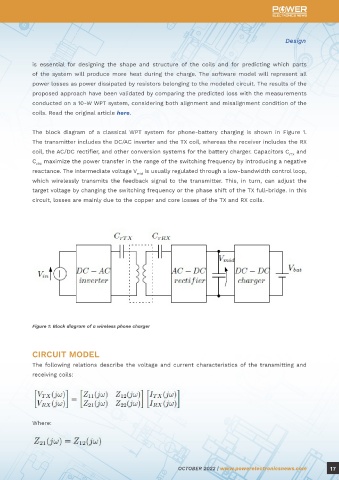
            The  block  diagram  of  a  classical  WPT  system  for  phone-battery  charging  is  shown  in  Figure  1.
            The transmitter includes the DC/AC inverter and the TX coil, whereas the receiver includes the RX
            coil, the AC/DC rectifier, and other conversion systems for the battery charger. Capacitors C  and
                                                                                                       rTX
            C  maximize the power transfer in the range of the switching frequency by introducing a negative
              rRX
            reactance. The intermediate voltage V   is usually regulated through a low-bandwidth control loop,
                                                 mid
            which wirelessly transmits the feedback  signal to the transmitter. This,  in turn,  can  adjust the
            target voltage by changing the switching frequency or the phase shift of the TX full-bridge. In this
            circuit, losses are mainly due to the copper and core losses of the TX and RX coils.


 A Software-Based


 Approach to Wireless


 Power Transfer


 Modeling


 By Stefano Lovati, technical writer for EEWeb  Figure 1: Block diagram of a wireless phone charger


 Wireless power transfer (WPT) is a process that has been known for quite some time, dating back
 to the invention of the Tesla coil. Due to some valuable benefits (lack of cables and connectors, as   CIRCUIT MODEL
 well as high isolation between power transmitter and receiver), this technology plays a relevant role   The following relations describe the voltage and current characteristics of the transmitting and
 today in applications such as EV charging, phone charging, medical devices, and more.  Based on   receiving coils:
 1,2
 the standard or on the inductive coupling process, WPT needs to achieve a high level of efficiency,
 minimizing the power losses.


 This  article  suggests  an  innovative  software-based  approach  to  the  modeling  of  WPT  circuits.
 By extracting the equivalent circuit for a given positioning of the coils, an accurate estimation of the   Where:
 power losses can be provided. In particular, the model can estimate the type of loss (conduction,
 eddy current, or core) and where it has originated (TX/RX winding or TX/RX core). Loss analysis


 16  OCTOBER 2022 | www.powerelectronicsnews.com                OCTOBER 2022 | www.powerelectronicsnews.com          17

