


Page 13 - PCIM and APEC 2021 - Technical Coverage, eBook
P. 13
PCIM - Automotive                                                                  APEC - AUTOMOTIVE


 Q. What are some of the products that onsemi offers to address this new system?


 A. onsemi has a broad automotive portfolio that can provide complete system solutions for 48-V

 MHEV systems. The central component is the fast discrete silicon power MOSFET. The onsemi MOSFET
 portfolio offers low-resistance, low-inductance devices in small, cost-efficient packages that help
 to minimize switching and conduction losses. This translates into high-efficiency operation of both
 the inverter and the 48- to 12-V bidirectional converter in the 48-V system with lower system costs.
 These  best-in-class  devices  are  complemented with  matching  gate  drivers.  onsemi’s  automotive
 power modules (APMs) are complete pre-wired one-half or three-phase bridge circuits that make it
 easy to build an inverter for the S/G or any 48-V motor in the system. The primary benefits of using an
 onsemi APM module in a 48-V system is that these integrated modules, with their compact footprint
 and high power density, have the ability to deliver high power when needed. This translates to cost

 and weight savings essential for CO2 emissions reduction. Additional solutions offered in onsemi’s
 portfolio to provide “one-stop shopping” are:  SiC Modules for EVs


 ▶   A new product line of operational amplifiers optimized for current sensing in the main drive   By Maurizio Di Paolo Emilio, editor-in-chief of Power Electronics
 motor and other critical circuits  News and European correspondent for EE Times
 ▶   High-speed digital isolators
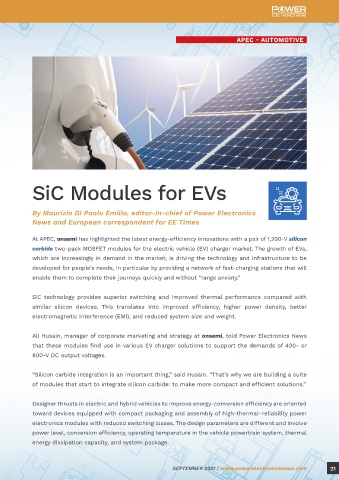
 ▶   Gate drivers   At APEC, onsemi has highlighted the latest energy-efficiency innovations with a pair of 1,200-V silicon

 ▶   High-efficiency DC/DC converters   carbide two-pack MOSFET modules for the electric vehicle (EV) charger market. The growth of EVs,
 ▶   Transceivers for CAN, LIN, and Flex Ray communications ESD/EMI protection components   which are increasingly in demand in the market, is driving the technology and infrastructure to be
 ▶   eFuse, a protective device that connects between the 48-V battery and the inverter  developed for people’s needs, in particular by providing a network of fast-charging stations that will
            enable them to complete their journeys quickly and without “range anxiety.”
 Q. Why 48 V?
            SiC technology  provides  superior  switching  and  improved thermal  performance  compared with
 A. Many have wondered why 48 V was selected as the new vehicle power source. First, it provides a   similar  silicon  devices.  This  translates  into  improved  efficiency,  higher  power  density,  better
 significant boost in power over a 12-V system. While a standard 12-V system can put out a maximum   electromagnetic interference (EMI), and reduced system size and weight.
 of 2 to 4 kW, the 48-V system can deliver up to 10−20 kW. The higher voltage does a better job of

 operating heavy-duty devices like pumps, compressors, turbos, and suspension components. A good   Ali Husain, manager of corporate marketing and strategy at onsemi, told Power Electronics News
 source of 48 V is a lithium-ion battery. Higher voltages reduce current levels for a given amount of   that these modules find use in various EV charger solutions to support the demands of 400- or
 power consumption. Less current means that smaller wiring can be used to reduce the size and   800-V DC output voltages.
 weight of the vehicle wiring harnesses. Finally, that level of voltage falls right below the threshold
 of human shock. Most individuals do not feel electrical shock from voltages below 50 to 60 V. That   “Silicon carbide integration is an important thing,” said Husain. “That’s why we are building a suite
 makes the 48-V systems generally safe for humans to operate, service, or troubleshoot.  of modules that start to integrate silicon carbide: to make more compact and efficient solutions.”


 For More Information  Designer thrusts in electric and hybrid vehicles to improve energy-conversion efficiency are oriented

            toward devices equipped with compact packaging and assembly of high-thermal–reliability power
            electronics modules with reduced switching losses. The design parameters are different and involve
   ▶ Live Coverage of PCIM 2021  power level, conversion efficiency, operating temperature in the vehicle powertrain system, thermal
            energy dissipation capacity, and system package.


 20  SEPTEMBER 2021 | www.powerelectronicsnews.com            SEPTEMBER 2021 | www.powerelectronicsnews.com          21

