


Page 15 - PCIM and APEC 2021 - Technical Coverage, eBook
P. 15
APEC - Automotive                                                                        APEC - ENERGY


 EV TECHNOLOGY

 The requirements in this sector are evolving rapidly, with power levels above 350 kW and efficiencies
 of 95% becoming the “norm.” Key parameters in this market are compactness, robustness, and

 increased reliability, which many companies are trying to solve with new technical solutions.


 “It is essential to take advantage of SiC for its high switching speed in order to reduce the size of
 various passive components,” said Husain. “With the increased efficiency and higher frequency of
 SiC, it is easier to address thermal challenges while also achieving a small form factor.”


 The new 1,200-V two-pack modules, based on planar technology and suitable for a drive voltage
 in the range of 18–20 V, can be driven with negative gate voltages. The larger die reduces thermal
 resistance compared with trench MOSFETs, thus lowering die temperature for the same operating

 temperature. The NXH010P120MNF is a half-bridge in an F1 package, while the NXH006P120MNF2
 is  a  6-mΩ  device  in  an  F2  package.  The  pins  are  push-pull  to  help  with  assembly  while  also   Megatrends in Energy
 incorporating a negative temperature coefficient thermistor for temperature monitoring. Husain
 also pointed out that the new modules can work with the NCD5700x, particularly the NCD57252,   Storage
 which offers 5-kV isolation for dual low-side, dual high-side, or half-bridge operation with typical
 propagation delays of 60 ns.
            By Maurizio Di Paolo Emilio, editor-in-chief of Power Electronics News and
            European correspondent for EE Times
 onsemi’s SiC technology also provides its 650-, 900-, and 1,200-V MOSFETs. The 650-V SiC MOSFETs
 employ a new active-cell design combined with advanced thin-wafer technology that enables a
 best-in-class figure of merit per (R   × area). The 1,200-V and 900-V N-channel ones feature a   Zero emissions is a  target many
 DS(on)
 small chip size that reduces device capacitance and gate charge (Qg as low as 220 nC), reducing   nations are willing to reach by 2050,
 switching losses when operating at the high frequencies required by EV chargers.  and investments have been allocated
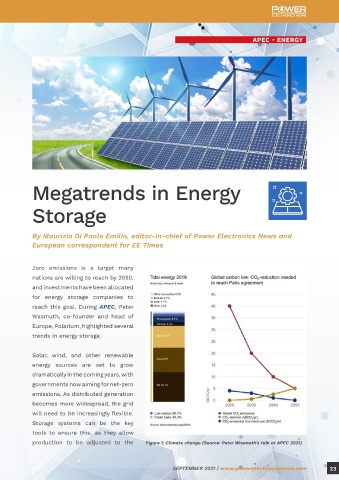
            for energy storage companies  to
 SiC offers a higher efficiency level than silicon, mainly due to significantly lower energy loss and   reach this goal. During APEC, Peter
 reverse charge. This leads to more switching power and less energy required in the switch-on and   Wasmuth,  co-founder  and  head  of
 switch-off phase. Lower heat loss also makes it possible to remove cooling systems, thus reducing   Europe, Polarium, highlighted several

 space,  weight,  and  infrastructure  cost.  The  high  thermal  conductivity  of  silicon  carbide  allows   trends in energy storage.
 better heat dissipation, offering smaller form factors than silicon. This allows cutting on lower costs
 and having smaller packaging.  Solar,  wind,  and  other  renewable
            energy  sources  are  set  to grow
            dramatically in the coming years, with
            governments now aiming for net-zero
            emissions. As distributed generation
 For More Information  becomes more widespread, the grid

            will need to be increasingly flexible.
            Storage  systems  can  be  the  key
   ▶ Live Coverage of APEC 2021  tools to  ensure this,  as they  allow
            production  to  be  adjusted  to  the   Figure 1: Climate change (Source: Peter Wasmuth's talk at APEC 2021)


 22  SEPTEMBER 2021 | www.powerelectronicsnews.com            SEPTEMBER 2021 | www.powerelectronicsnews.com          23

