


Page 9 - PCIM and APEC 2021 - Technical Coverage, eBook
P. 9
APEC - MOTOR                                                                                 APEC - Motor


            Figure 1: Expectation with SiC MOSFET compared with Si devices


            SiC’s elevated electron mobility enables faster switching speeds to be supported. These faster
            switching speeds mean that, in turn, the associated switching losses will be reduced. Its dielectric
            breakdown field strength is almost an order of magnitude higher than Si. This allows a thinner
            drift layer to be implemented, which translates into lower on-resistance figures. Also, as SiC has

            triple the thermal  conductivity  of  Si,  and  it  is  much  more  effective  at  dissipating  heat  energy.
            Consequently, thermal stresses are much easier to mitigate.


            Conventional  high-voltage  motor  drives  will  have  a  three-phase  inverter  arrangement,  with  Si
            IGBTs  accompanied  by  integrated  anti-parallel  diodes.  The  three  half-bridge  phases  drive  the
            corresponding phase coils of the inverter to deliver a sinusoidal current waveform that subsequently
            runs the motor. The energy wasted in the inverter will come from two main sources — namely

            conduction losses and switching losses. By replacing the Si-based with SiC-based switches, both
 Silicon Carbide’s Role   of these losses can successfully be combated.


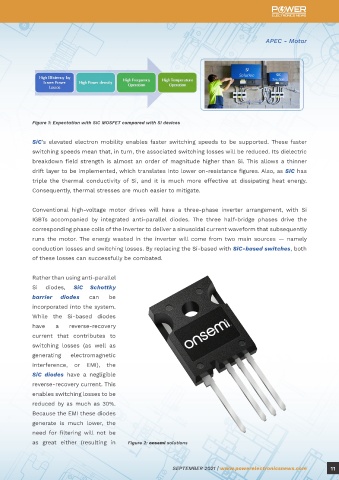
            Rather than using anti-parallel
 in Next-Generation   Si   diodes,   SiC Schottky

            barrier
                                can
                      diodes
                                       be
 Industrial Motor Drives  incorporated into the system.
            While  the  Si-based  diodes
            have     a   reverse-recovery

 By Corporate Marketing at onsemi   current that  contributes to
            switching  losses  (as  well  as
 The International Energy Agency (IEA) at onsemi estimates that motors are responsible for more   generating  electromagnetic
 than 45% of the world’s total electricity. Thus, finding ways to maximize their operational efficiency   interference,  or  EMI),  the
 is paramount. Higher-efficiency drives can be smaller and moved closer to the motor, which reduces   SiC diodes have a negligible
 challenges arising from long cables. This will have relevance from an overall cost and ongoing reliability   reverse-recovery current. This
 perspective. The advent of wide-bandgap (WBG) semiconductor technology is expected to play a   enables switching losses to be

 major role in enabling new motor efficiency and form-factor benchmarks to be achieved.  reduced by as much as 30%.
            Because the EMI these diodes
 The use of WBG materials, such as silicon carbide (SiC), means that devices can be fabricated and   generate is much lower,  the
 are able to outperform their silicon (Si) equivalents. Though there are various key opportunities for   need  for  filtering  will  not  be
 this technology, industrial motor drives are receiving the greatest interest and attention.  as  great  either  (resulting  in   Figure 2: onsemi solutions


 10  SEPTEMBER 2021 | www.powerelectronicsnews.com            SEPTEMBER 2021 | www.powerelectronicsnews.com          11

