


Page 43 - 23_EETE_03
P. 43
EE|Times EUROPE   43

                                                       The Status of Room-Temperature Quantum Computers


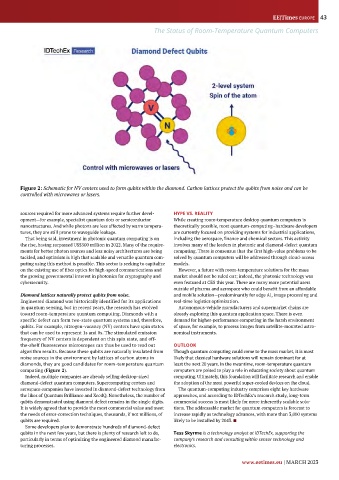
        Figure 2: Schematic for NV centers used to form qubits within the diamond. Carbon lattices protect the qubits from noise and can be
        controlled with microwaves or lasers.


        sources required for more advanced systems require further devel-  HYPE VS. REALITY
        opment—for example, specialist quantum dots or semiconductor   While creating room-temperature desktop quantum computers is
        nanostructures. And while photons are less affected by warm tempera-  theoretically possible, most quantum-computing–hardware developers
        tures, they are still prone to waveguide leakage.     are currently focused on providing systems for industrial applications,
          That being said, investment in photonic quantum computing is on   including the aerospace, finance and chemical sectors. This activity
        the rise, having surpassed US$500 million in 2022. Many of the require-  involves many of the leaders in photonic and diamond-defect quantum
        ments for better photon sources and less noisy architectures are being   computing. There is consensus that the first high-value problems to be
        tackled, and optimism is high that scalable and versatile quantum com-  solved by quantum computers will be addressed through cloud-access
        puting using this method is possible. This sector is seeking to capitalize   models.
        on the existing use of fiber optics for high-speed communications and   However, a future with room-temperature solutions for the mass
        the growing governmental interest in photonics for cryptography and   market should not be ruled out; indeed, the photonic technology was
        cybersecurity.                                        even featured at CES this year. There are many more potential users
                                                              outside of pharma and aerospace who could benefit from an affordable
        Diamond lattices naturally protect qubits from noise.  and mobile solution—predominantly for edge AI, image processing and
        Engineered diamond was historically identified for its applications   real-time logistics optimization.
        in quantum sensing, but in recent years, the research has evolved   Autonomous-vehicle manufacturers and supermarket chains are
        toward room-temperature quantum computing. Diamonds with a   already exploring this quantum application space. There is even
        specific defect can form two-state quantum systems and, therefore,   demand for higher-performance computing in the harsh environment
        qubits. For example, nitrogen-vacancy (NV) centers have spin states   of space, for example, to process images from satellite-mounted astro-
        that can be used to represent 1s and 0s. The stimulated emission   nomical instruments.
        frequency of NV centers is dependent on this spin state, and off-
        the-shelf fluorescence microscopes can thus be used to read out   OUTLOOK
        algorithm results. Because these qubits are naturally insulated from   Though quantum computing could come to the mass market, it is most
        noise sources in the environment by lattices of carbon atoms in   likely that classical hardware solutions will remain dominant for at
        diamonds, they are good candidates for room-temperature quantum   least the next 20 years. In the meantime, room-temperature quantum
        computing (Figure 2).                                 computers are poised to play a role in educating society about quantum
          Indeed, multiple companies are already selling desktop-sized   computing. Ultimately, this foundation will facilitate research and enable
        diamond-defect quantum computers. Supercomputing centers and   the adoption of the most powerful super-cooled devices on the cloud.
        aerospace companies have invested in diamond-defect technology from   The quantum-computing industry comprises eight key hardware
        the likes of Quantum Brilliance and XeedQ. Nonetheless, the number of   approaches, and according to IDTechEx’s research study, long-term
        qubits demonstrated using diamond defect remains in the single digits.   commercial success is most likely for more inherently scalable solu-
        It is widely agreed that to provide the most commercial value and meet   tions. The addressable market for quantum computers is forecast to
        the needs of error-correction techniques, thousands, if not millions, of   increase rapidly as technology advances, with more than 3,000 systems
        qubits are required.                                  likely to be installed by 2043. ■
          Some developers plan to demonstrate hundreds of diamond-defect
        qubits in the next few years, but there is plenty of research left to do,   Tess Skyrme is a technology analyst at IDTechEx, supporting the
        particularly in terms of optimizing the engineered diamond manufac-  company’s research and consulting within sensor technology and
        turing processes.                                     electronics.

                                                                                      www.eetimes.eu | MARCH 2023

