


Page 42 - 23_EETE_03
P. 42
42 EE|Times EUROPE


         QUANTUM COMPUTING
        The Status of Room-Temperature Quantum


        Computers


        By Tess Skyrme, IDTechEx

                uantum computers promise to master problems that would   improve accessibility to quantum computing and ultimately result in a
                take classical computers trillions of years to solve. Stand-  larger addressable market.
                ing in the way of broad deployment, however, is that most
        Qquantum computer designs depend on cooling the hardware   Photonic qubits can survive warm temperatures.
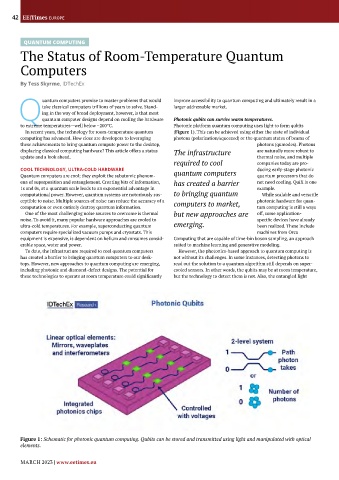
        to extreme temperatures—well below –200°C.            Photonic platform quantum computing uses light to form qubits
          In recent years, the technology for room-temperature quantum   (Figure 1). This can be achieved using either the state of individual
        computing has advanced. How close are developers to leveraging   photons (polarization/squeezed) or the quantum states of beams of
        these achievements to bring quantum compute power to the desktop,                  photons (qumodes). Photons
        displacing classical computing hardware? This article offers a status   The infrastructure   are naturally more robust to
        update and a look ahead.                                                           thermal noise, and multiple
                                                              required to cool             companies today are pro-
        COOL TECHNOLOGY, ULTRA-COLD HARDWARE                  quantum computers            ducing early-stage photonic
        Quantum computers are cool; they exploit the subatomic phenom-                     quantum processors that do
        ena of superposition and entanglement. Creating bits of information,   has created a barrier   not need cooling. QuiX is one
        1s and 0s, at a quantum scale leads to an exponential advantage in                 example.
        computational power. However, quantum systems are notoriously sus-  to bringing quantum   While scalable and versatile
        ceptible to noise. Multiple sources of noise can reduce the accuracy of a   computers to market,   photonic hardware for quan-
        computation or even entirely destroy quantum information.                          tum computing is still a ways
          One of the most challenging noise sources to overcome is thermal   but new approaches are   off, some application-
        noise. To avoid it, many popular hardware approaches are cooled to                 specific devices have already
        ultra-cold temperatures. For example, superconducting quantum   emerging.          been realized. These include
        computers require specialized vacuum pumps and cryostats. This                     machines from Orca
        equipment is expensive, is dependent on helium and consumes consid-  Computing that are capable of time-bin boson sampling, an approach
        erable space, water and power.                        suited to machine learning and generative modeling.
          To date, the infrastructure required to cool quantum computers   However, the photonics-based approach to quantum computing is
        has created a barrier to bringing quantum computers to our desk-  not without its challenges. In some instances, detecting photons to
        tops. However, new approaches to quantum computing are emerging,   read out the solution to a quantum algorithm still depends on super-
        including photonic and diamond-defect designs. The potential for   cooled sensors. In other words, the qubits may be at room temperature,
        these technologies to operate at room temperature could significantly   but the technology to detect them is not. Also, the entangled light


        Figure 1: Schematic for photonic quantum computing. Qubits can be stored and transmitted using light and manipulated with optical
        elements.

        MARCH 2023 | www.eetimes.eu

