


Page 25 - EETimes Europe June 2021
P. 25
EE|Times EUROPE   25

                                             Tools Move Up the Value Chain to Take the Mystery Out of Vision AI


             The Kria SOMs also enable customization and optimization for   time, for embedded-vision systems development. The cloud-based
           embedded developers with support for standard Yocto-based    approaches offer tools that “democratize” the ability to create and train
           PetaLinux.                                            models and evaluate hardware for extremely rapid deployment onto
             Xilinx said a collaboration with Canonical is also in progress to   embedded devices. And the approach that offers a module, or reference
           provide support for Ubuntu Linux, the highly popular Linux distribu-  design, with an app library allows AI developers to use existing tools to
           tion used by AI developers. This offers widespread familiarity with AI   create embedded-vision systems quickly.
           developers and interoperability with existing applications.   These are all moving us to a different way of looking at development
             Customers can develop in either environment and take either   boards and tools. They take the mystery out of embedded vision by
           approach to production. Both environments will come pre-built with   moving up the value chain, leaving the foundational-level work to the
           a software infrastructure and helpful utilities.      vendors’ tools and modules. ■
             We’ve highlighted three of the approaches that vendors are taking
           to address the skills and knowledge gap, as well as the deployment   Nitin Dahad is editor-in-chief of Embedded.


            SPECIAL REPORT: EMBEDDED VISION
           Synaptics Makes a Natural Progression


           to Edge AI


           By Gina Roos

                  t one time, Synaptics Inc. was best
                  known for its interface products,
                  including fingerprint sensors,
           A touchpads, and display drivers for
           PCs and mobile phones. Today, propelled
           by several acquisitions over the past several
           years, the company is making a big push into
           consumer IoT as well as computer-vision and
           artificial-intelligence solutions at the edge.
           Synaptics sees opportunities in computer
           vision across all markets and recently launched
           edge-AI processors that target real-time
           computer-vision and multimedia applications.
             The company’s recent AI roadmap
           spans from enhancing the image quality of
           high-resolution cameras using the high-
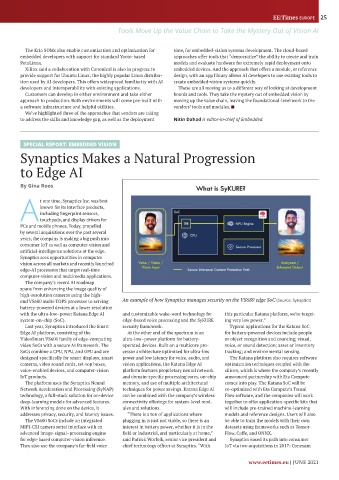
           end VS680 multi-TOPS processor to serving   An example of how Synaptics manages security on the VS680 edge SoC (Source: Synaptics)
           battery-powered devices at a lower resolution
           with the ultra-low–power Katana Edge AI   and customizable wake-word technology for   this particular Katana platform, we’re target-
           system-on-chip (SoC).               edge-based voice processing and the SyKURE   ing very low power.”
             Last year, Synaptics introduced the Smart   security framework.         Typical applications for the Katana SoC
           Edge AI platform, consisting of the    At the other end of the spectrum is an   for battery-powered devices include people
           VideoSmart VS600 family of edge-computing   ultra-low–power platform for battery-   or object recognition and counting; visual,
           video SoCs with a secure AI framework. The   operated devices. Built on a multicore pro-  voice, or sound detection; asset or inventory
           SoCs combine a CPU, NPU, and GPU and are   cessor architecture optimized for ultra-low   tracking; and environmental sensing.
           designed specifically for smart displays, smart   power and low latency for voice, audio, and   The Katana platform also requires software
           cameras, video sound cards, set-top boxes,   vision applications, the Katana Edge AI   optimization techniques coupled with the
           voice-enabled devices, and computer-vision   platform features proprietary neural network   silicon, which is where the company’s recently
           IoT products.                       and domain-specific processing cores, on-chip   announced partnership with Eta Compute
             The platform uses the Synaptics Neural   memory, and use of multiple architectural   comes into play. The Katana SoC will be
           Network Acceleration and Processing (SyNAP)   techniques for power savings. Katana Edge AI   co-optimized with Eta Compute’s Tensai
           technology, a full-stack solution for on-device   can be combined with the company’s wireless   Flow software, and the companies will work
           deep-learning models for advanced features.   connectivity offerings for system-level mod-  together to offer application-specific kits that
           With inferencing done on the device, it   ules and solutions.           will include pre-trained machine-learning
           addresses privacy, security, and latency issues.  “There is a ton of applications where   models and reference designs. Users will also
             The VS600 SoCs include an integrated   plugging in is just not viable, so there is an   be able to train the models with their own
           MIPI-CSI camera serial interface with an   interest in battery power, whether it is in the   datasets using frameworks such as Tensor-
           advanced image-signal–processing engine   field or industrial, and particularly at home,”   Flow, Caffe, and ONNX.
           for edge-based computer-vision inference.   said Patrick Worfolk, senior vice president and   Synaptics eased its path into consumer
           They also use the company’s far-field voice   chief technology officer at Synaptics. “With   IoT via two acquisitions in 2017: Conexant

                                                                                           www.eetimes.eu | JUNE 2021

