


Page 42 - EETEurope FlipBook February
P. 42
42 EE|Times EUROPE


                MARKET & TECHNOLOGY TRENDS
               IoT Clothing: The Next Generation of Wearables


               By John Koon


                                                                                                                          IMAGE: SHUTTERSTOCK


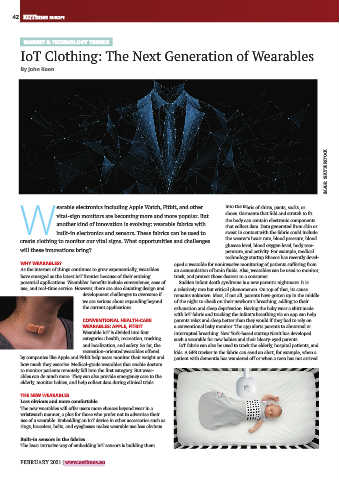
                            earable electronics including Apple Watch, Fitbit, and other   into the fabric of shirts, pants, socks, or
                            vital-sign monitors are becoming more and more popular. But   shoes. Garments that fold and stretch to fit
                                                                                       the body can contain electronic components
                            another kind of innovation is evolving: wearable fabrics with   that collect data. Data generated from skin or
               Wbuilt-in electronics and sensors. These fabrics can be used to         sweat in contact with the fabric could include
                                                                                       the wearer’s heart rate, blood pressure, blood
               create clothing to monitor our vital signs. What opportunities and challenges
                                                                                       glucose level, blood oxygen level, body tem-
               will these innovations bring?                                           perature, and activity. For example, medical
                                                                                       technology startup Rhaeos has recently devel-
               WHY WEARABLES?                                        oped a wearable for noninvasive monitoring of patients suffering from
               As the internet of things continues to grow exponentially, wearables   an accumulation of brain fluids. Also, wearables can be used to monitor,
               have emerged as the latest IoT frontier because of their enticing   track, and protect those dearest to a consumer.
               potential applications. Wearables’ benefits include convenience, ease of   Sudden infant death syndrome is a new parent’s nightmare. It is
               use, and real-time service. However, there are also daunting design and   a relatively rare but critical phenomenon. On top of that, its cause
                                     development challenges to overcome if   remains unknown. Most, if not all, parents have gotten up in the middle
                                     we are serious about expanding beyond   of the night to check on their newborn’s breathing, adding to their
                                     the current applications.       exhaustion and sleep deprivation. Having the baby wear a shirt made
                                                                     with IoT fabric and tracking the infant’s breathing via an app can help
                                     CONVENTIONAL HEALTH-CARE        parents relax and sleep better than they would if they had to rely on
                                     WEARABLES: APPLE, FITBIT        a conventional baby monitor. The app alerts parents to abnormal or
                                     Wearable IoT is divided into four   interrupted breathing. New York-based startup Nanit has developed
                                     categories: health, recreation, tracking   such a wearable for new babies and their bleary-eyed parents.
                                     and localization, and safety. So far, the   IoT fabric can also be used to track the elderly, hospital patients, and
                                     recreation-oriented wearables offered   kids. A GPS tracker in the fabric can send an alert, for example, when a
               by companies like Apple and Fitbit help users monitor their weight and   patient with dementia has wandered off or when a teen has not arrived
               how much they exercise. Medical-grade wearables that enable doctors
               to monitor patients remotely fall into the first category. But wear-
               ables can do much more. They can also provide emergency care to the
               elderly, monitor babies, and help collect data during clinical trials.
               THE NEW WEARABLES
               Less obvious and more comfortable
               The new wearables will offer users more choices beyond wear in a
               wristwatch manner, a plus for those who prefer not to advertise their
               use of a wearable. Embedding an IoT device in other accessories such as
               rings, bracelets, belts, and eyeglasses makes wearable use less obvious.

               Built-in sensors in the fabrics
               The least intrusive way of embedding IoT sensors is building them


               FEBRUARY 2021 | www.eetimes.eu

