


Page 45 - EE|Times Europe Magazine - December 2020
P. 45
EE|Times EUROPE   45

                                                    Real-Life Scenarios: How the Industrial Cloud Gets Hacked


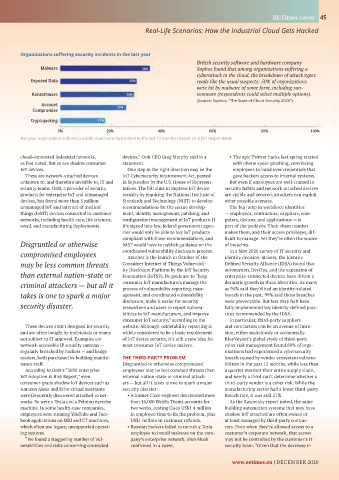
        Organizations suffering security incidents in the last year
                                                                      British security software and hardware company
               Malware                              34%               Sophos found that among organizations suffering a
                                                                      cyberattack in the cloud, the breakdown of attack types
            Exposed Data                       29%                    reads like the usual suspects: 50% of organizations
                                                                      were hit by malware of some form, including ran-
            Ransomware                       28%                      somware (respondents could select multiple options).
                                                                      (Source: Sophos, “The State of Cloud Security 2020”)
                Account
            Compromise                    25%
            Cryptojacking          17%
                     0%               20%               40%               60%                80%              100%
        Has your organization suffered a public cloud security incident in the last 12 months? Based on 3,521 respondents


        cloud-connected industrial networks,    devices,” Ordr CEO Greg Murphy said in a   •  The epic Twitter hacks last spring started
        as Fier noted. But so are shadow consumer   statement.                     with phone spear-phishing, convincing
        IoT devices.                          One step in the right direction may be the   employees to hand over credentials that
          These are network-attached devices   IoT Cybersecurity Improvement Act, passed   gave hackers access to internal systems.
        unknown to, and therefore invisible to, IT and   in September by the U.S. House of Represen-  But even if employees are well-trained in
        security teams. Ordr, a provider of security   tatives. The bill aims to improve IoT device   security habits and network-attached devices
        products for enterprise IoT and unmanaged   security by requiring the National Institute of   are visible and secured, attackers can exploit
        devices, has found more than 5 million   Standards and Technology (NIST) to develop   other possible avenues.
        unmanaged IoT and internet of medical   recommendations for the secure develop-  The big jump in workforce identities
        things (IoMT) devices connected to customer   ment, identity management, patching, and   — employees, contractors, suppliers, com-
        networks, including health care, life sciences,   configuration management of IoT products. If   puters, devices, and applications — is
        retail, and manufacturing deployments.   it’s signed into law, federal government agen-  part of the problem: Their sheer number
                                            cies would only be able to buy IoT products   makes them, and their access privileges, dif-
                                            compliant with those recommendations, and   ficult to manage. Yet they’re often the source
        Disgruntled or otherwise            NIST would have to publish guidance on the   of breaches.
                                                                                  In a May 2020 survey of IT security and
        compromised employees               coordinated vulnerability disclosure process.   identity decision-makers, the Identity
                                              Another is the launch in October of the
        may be less common threats          Consumer Internet of Things Vulnerabil-  Defined Security Alliance (IDSA) found that
        than external nation-state or       ity Disclosure Platform by the IoT Security   automation, DevOps, and the expansion of
                                                                                enterprise-connected devices have driven a
                                            Foundation (IoTSF). Its goals are to “help
        criminal attackers — but all it     consumer IoT manufacturers manage the   dramatic growth in these identities. As many
                                            process of vulnerability reporting, man-
                                                                                as 94% said they’d had an identity-related
        takes is one to spark a major       agement, and coordinated vulnerability   breach in the past; 99% said those breaches
        security disaster.                  disclosure, make it easier for security   were preventable. But less than half have
                                            researchers and users to report vulnera-
                                                                                fully implemented key identity-defined prac-
                                            bilities to IoT manufacturers, and improve   tices recommended by the IDSA.
                                            consumer IoT security,” according to the   In particular, third-party suppliers
          These devices aren’t designed for security   website. Although vulnerability reporting is   and contractors can be an avenue of intru-
        and are often bought by individuals or teams   widely considered to be a basic requirement   sion, either maliciously or accidentally.
        not subject to IT approval. Examples are   of IoT device security, it’s still a new idea for   BlueVoyant’s global study of third-party
        network-accessible IP security cameras —    most consumer IoT device makers.  cyber risk management found 80% of orga-
        regularly breached by hackers — and badge                               nizations had experienced a cybersecurity
        readers, both purchased by building mainte-  THE THIRD-PARTY PROBLEM    breach caused by vendor ecosystem vulnera-
        nance staff.                        Disgruntled or otherwise compromised   bilities in the past 12 months, while less than
          According to Ordr’s “2020 Enterprise    employees may be less common threats than   a quarter monitor their entire supply chain,
        IoT Adoption & Risk Report,” even    external nation-state or criminal attack-  and nearly a third can’t determine whether a
        consumer-grade shadow IoT devices such as   ers — but all it takes is one to spark a major   third-party vendor is a cyber risk. While the
        Amazon Alexa and Echo virtual assistants   security disaster:           manufacturing sector had a lower third-party
        were frequently discovered attached to net-  •  A former Cisco engineer deactivated more   breach rate, it was still 57%.
        works. So were a Tesla and a Peloton exercise   than 16,000 WebEx Teams accounts for   As the Kaspersky report noted, the same
        machine. In some health-care companies,   two weeks, costing Cisco US$1.4 million   building automation systems that may have
        employees were running YouTube and Face-  in employee time to fix the problem, plus   shadow IoT attached are often owned or
        book applications on MRI and CT machines,   US$1 million in customer refunds.  at least managed by third-party contrac-
        which often use legacy, unsupported operat-  •  Russian hackers failed to recruit a Tesla   tors. Even when they’re allowed access to a
        ing systems.                           employee to install malware on the com-  customer’s corporate network, that access
          “We found a staggering number of vul-  pany’s enterprise network, Elon Musk   may not be controlled by the customer’s IT
        nerabilities and risks concerning connected   confirmed in a tweet.     security team. “Given that the decrease in

                                                                                   www.eetimes.eu | DECEMBER 2020

