


Page 23 - EE Times Europe Magazine | February 2020
P. 23
EE|Times EUROPE   21
                                                                                              Optimized for Success


                                                                                    need for safety software — different safety
                                                                                    mechanisms can now be exercised through
                                                                                    hardware built-in self-tests.
                                                                                      Computing performance has been
                                                                                    increased with the introduction of the new
                                                                                    TriCore generation (1.62) with new instruc-
                                                                                    tions, up to six CPUs running at 300 MHz, as
                                                                                    well as reduced latencies with direct path for
                                                                                    flash access.
                                                                                      On the memory side, not only have
                                                                                    capacities been increased, but the memory
                                                                                    protection unit (MPU) has been further
                                                                                    improved.
                                                                                      The TC3xx family incorporates various
                                                                                    high-performance AD converters. Four types
                                                                                    of converters are integrated: primary SAR (12
                                                                                    bit), secondary SAR (12 bit), fast compare (10
                                                                                    bit), and delta-sigma. The converters offer
                                                                                    conversion rates from 1 to 40 MSamples/s.
                                                                                      The optimized ADAS functionality of the
                                                                                    AURI  TC xx family benefits radar systems
                                                                                    in particular (Figure 4), from blind-spot
                                                                                    detection to front and corner radar systems.
                                                                                    The TC3xx offers the previously mentioned
                                                                                    radar-processing unit with up to two SPUs,
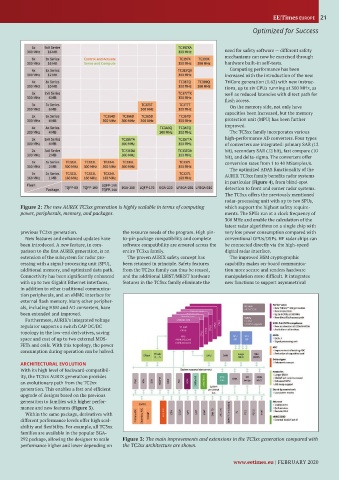
            Figure 2: The new AURIX TC3xx generation is highly scalable in terms of computing   which support the highest safety require-
            power, peripherals, memory, and packages.                               ments. The SPUs run at a clock frequency of
                                                                                    300 MHz and enable the calculation of the
                                                                                    latest radar algorithms on a single chip with
            previous TC2xx generation.          the resource needs of the program. High pin-  very low power consumption compared with
              New features and enhanced updates have   to-pin package compatibility and complete   conventional GPUs/DSPs. HF radar chips can
            been introduced. A new feature, in com-  software compatibility are ensured across the   be connected directly via the high-speed
            parison to the first AURI  generation, is an   entire TC3xx family.     digital radar interface.
            extension of the subsystem for radar pro-  The proven AURI  safety concept has   The improved HSM cryptographic
            cessing with a signal-processing unit (SPU),   been retained in principle. Safety features   capability makes on-board communica-
            additional memory, and optimized data path.   from the TC2xx family can thus be reused,   tion more secure and renders hardware
            Connectivity has been significantly enhanced   and the additional LBIST MBIST hardware   manipulation more difficult. It integrates
            with up to two Gigabit Ethernet interfaces,   features in the TC3xx family eliminate the   new functions to support asymmetrical
            in addition to other traditional communica-
            tion peripherals, and an eMMC interface for
            external flash memory. Many other peripher-
            als, including HSM and AD converters, have
            been extended and improved.
              Furthermore, AURI ’s integrated voltage
            regulator supports a switch CAP DC/DC
            topology in the low-end derivatives, saving
            space and cost of up to two external MOS-
            FETs and coils. With this topology, the power
            consumption during operation can be halved.

            ARCHITECTURAL EVOLUTION
            With its high level of backward-compatibil-
            ity, the TC xx AURI  generation provides
            an evolutionary path from the TC2xx
            generation. This enables a fast and efficient
            upgrade of designs based on the previous
            generation to families with higher perfor-
            mance and new features (Figure 3).
              Within the same package, derivatives with
            different performance levels offer high scal-
            ability and flexibility. For example, all TC xx
            families are available in the popular BGA-
            292 package, allowing the designer to scale   Figure 3: The main improvements and extensions in the TC3xx generation compared with
            performance higher and lower depending on   the TC2xx architecture are shown.

                                                                                       www.eetimes.eu | FEBRUARY 2020ww.eetimes.eu | FEBRUARY 2020www.eetimes.eu | FEBRUARY 2020
            FEBRUAR                                                                    w
            FEBRUARY 2020 | www.eetimes.euY 2020 | www.eetimes.eu

