


Page 6 - PowerUp 2021 Conference Proceedings for PEN
P. 6
WIDE BANDGAP


            SiC Power Technology


            Status and Barriers to


            Mass Commercialization


            By Victor Veliadis, professor of electrical and computer engineering at North
            Carolina State University and executive director and CTO of PowerAmerica


            Silicon (Si) power devices have dominated power electronics due  to  their low-cost  volume
            production, excellent starting material quality, ease of fabrication, and proven reliability. Although
            Si power devices continue to improve, they are approaching their operational limits primarily due
            to their relatively low bandgap, critical electric field, and thermal conductivity that result in high
            conduction and switching losses, as well as poor high-temperature performance. Silicon carbide’s
            (SiC’s) large bandgap and critical electric field allow for high-voltage devices with thinner layers,

            which lowers resistance and associated conduction and switching losses. Combined with SiC’s large
            thermal conductivity, high-temperature operation at high power levels is possible with simplified
            thermal management. Furthermore, thinner device layers and low specific on-resistance allow for
            a smaller form factor that reduces capacitance. This enables efficient operation at frequencies well
            above those of silicon, which minimizes the size of passive system components. Thus, the SiC-
            based system is more efficient, lighter, has smaller volume, and is cost-competitive (despite the
            higher-than-Si device cost), as bulky magnetics and heatsinks are minimized.


            These compelling efficiency and system benefits have led to significant development efforts over

            the last two decades, as SiC planar and trench MOSFETs and JFETs are commercially available
            from  several  vendors  as  discrete  components  and  high-power  modules  in  the  650-  to  1,700-V
            voltage range. Presently, power-electronic engineers can select Si, SiC, and gallium nitride (GaN)
            components for use in their systems. There are, of course, numerous tradeoffs when selecting the
            right material device for an application and voltage: Current, frequency, efficiency, temperature,
            and cost are important considerations.


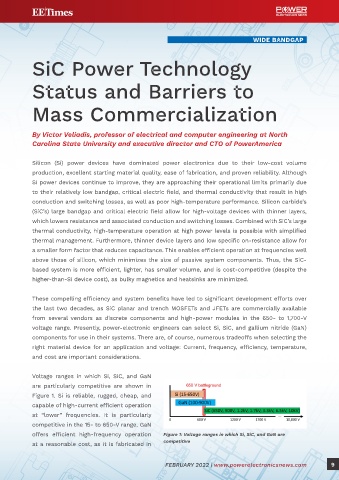
            Voltage ranges in which Si, SiC, and GaN
            are particularly competitive are shown in
            Figure 1. Si is reliable, rugged, cheap, and
            capable of high-current efficient operation
            at  “lower”  frequencies.  It  is  particularly
            competitive in the 15- to 650-V range. GaN
            offers  efficient  high-frequency  operation   Figure 1: Voltage ranges in which Si, SiC, and GaN are
            at a reasonable cost, as it is fabricated in   competitive


                                                           FEBRUARY 2022 | www.powerelectronicsnews.com              9

