


Page 49 - Power Electronics News - December 2020
P. 49
Test & Measurements                                                                     Test & Measurements


 and internal chip power distribution, but every in-  the design. Notice the large coinciding spur at the red   and every active component can

 terconnect, trace, via, connector, capacitor, pack-  marker in Figure 4. The TIE histogram to the right of   alter the voltages of power rails
 age, pins, and ball-grids.   the TIE spectrum has the signature sinusoidal jitter   and ground planes.
 distribution (horseshoe), PJ at one frequency.
                                                                                The eye diagram can tell us a
 THE IMPACT OF RIPPLE ON   Power supplies can introduce random noise that       lot about signal integrity, but it

 RANDOM AND PERIODIC JITTER   contributes to RJ. The power rail random noise    rarely helps us identify specific
 Power rail noise, often called ripple, is typically a   shows up as the noise floor of the Spectrum View   problems. Analysis of the TIE
 few millivolts. Accurate measurements of mV noise   plot in the upper left in Figure 4. RJ is calculated   distribution breaks jitter into
 on a power rail at GHz frequencies requires high   from the noise floor of the TIE spectrum. In this   components that provide clues

 bandwidth probes with high DC impedance that   example, the random noise due to power ripple is   of where problems lie. High RJ
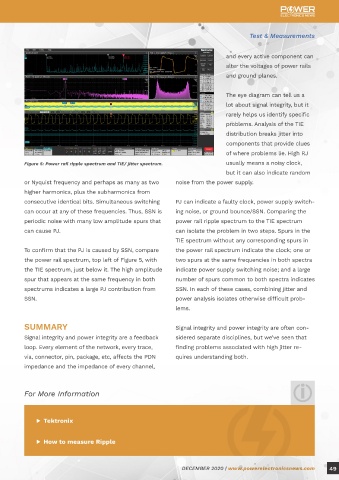
 act as 50 Ω transmission lines at high-frequencies.   very low, and RJ is tiny, about 0.84 ps.  Figure 5: Power rail ripple spectrum and TIE/ jitter spectrum.  usually means a noisy clock,
 Power rail probes are designed explicitly for this                             but it can also indicate random
 purpose.   or Nyquist frequency and perhaps as many as two    noise from the power supply.
 PJ & GROUND BOUNCE  higher harmonics, plus the subharmonics from

 Switch-mode power supplies regulate the voltage   During logic transitions, transmitters and receivers   consecutive identical bits. Simultaneous switching   PJ can indicate a faulty clock, power supply switch-
 between the power rail and the return path (a.k.a.,   source or sink current from the PDN. When multi-  can occur at any of these frequencies. Thus, SSN is   ing noise, or ground bounce/SSN. Comparing the

 “ground”) by continuously switching between low   ple signals switch between levels simultaneously,   periodic noise with many low amplitude spurs that   power rail ripple spectrum to the TIE spectrum
 dissipation on and off states. Unfortunately, the   they can deposit or remove substantial charge from   can cause PJ.  can isolate the problem in two steps. Spurs in the
 pulses that drive the switching elements can in-  the power rail and/or ground plane. The short-term   TIE spectrum without any corresponding spurs in
 duce “switching noise” and cause PJ.  introduction of charge density alters the voltage   To confirm that the PJ is caused by SSN, compare   the power rail spectrum indicate the clock; one or
 of what should be a common ground across the   the power rail spectrum, top left of Figure 5, with   two spurs at the same frequencies in both spectra
 Switching occurs at fixed frequencies that should   conductor. The resulting voltage variation is called   the TIE spectrum, just below it. The high amplitude   indicate power supply switching noise; and a large
 be recorded on the DC-to-DC converter data sheet.   ground bounce or, equivalently, simultaneous   spur that appears at the same frequency in both   number of spurs common to both spectra indicates
 If the ripple spectrum, top left of Figure 4, and the   switching noise (SSN).  spectrums indicates a large PJ contribution from   SSN. In each of these cases, combining jitter and
 TIE spectrum, just below it, both have spurs at the   SSN.    power analysis isolates otherwise difficult prob-

 switching frequencies or harmonics of switching fre-  Before continuing, we should clarify a couple of   lems.
 quencies, then we know the source and can address   things. First, by “ground” we’re referring to the de-
 sired common reference volt-  SUMMARY                         Signal integrity and power integrity are often con-
 age of the return path which is   Signal integrity and power integrity are a feedback   sidered separate disciplines, but we’ve seen that
 usually defined to be 0 V. Sec-  loop. Every element of the network, every trace,   finding problems associated with high jitter re-
 ond, “simultaneous” means that   via, connector, pin, package, etc, affects the PDN   quires understanding both.
 the components source or sink   impedance and the impedance of every channel,

 charge during the time interval
 when their rise/fall times over-
 lap.     For More Information


 SSN looks random in the time
 domain but not in the frequen-    ▶ Tektronix
 cy domain. Data signals are
 composed of many frequency     ▶ How to measure Ripple
 Figure 4: : Power rail ripple in Spectrum View top left, and TIE spectrum just below
 it, along with the signal and power rail waveforms and the TIE histogram.  components—the fundamental

 48  DECEMBER 2020 | www.powerelectronicsnews.com                DECEMBER 2020 | www.powerelectronicsnews.com        49

