


Page 46 - Power Electronics News - December 2020
P. 46
Test & Measurements                                                                                                                                                                                   Test & Measurements


                                                                                                                                                                                                       that is uncorrelated, such as PJ

                                                                                                                                                                                                       (periodic jitter).


                                                                                                                                                                                                       Widespread crossings on the eye
                                                                                                                                                                                                       diagrams can indicate RJ. Eyes
                                                                                                                                                                                                       that appear to consist of many
                                                                                                                                                                                                       nearly distinct lines indicate
                                                                                                                                                                                                       DDJ, likely from impedance mis-
                                                                                                                                                                                                       matches in the signal path. More
                                                                                                                                                                                                       detailed measurements are

                                                                                                                                                                                                       needed to identify the types of
                                                                                                                                 Figure 3: Jitter summary screenshot, clockwise from top left: bathtub plot, eye   jitter that can indicate hardware
                                                                                                                                 diagram, TIE spectrum, jitter analysis results, waveform, TIE histogram.  bugs: TIE, RJ, DJ, DDJ, PJ, TJ (to-
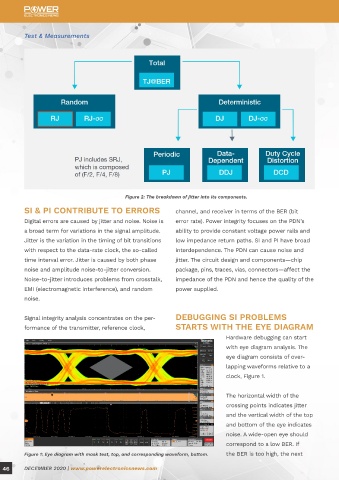
                                                                                                                                 step is to perform a jitter analysis. Figure 2 maps   tal jitter), EH (eye height), EW (eye width), eye high,
                                                                                                                                 the breakdown of jitter into its components and      and eye low.  Table 1 lists different types of jitter
                                             Figure 2: The breakdown of jitter into its components.
                                                                                                                                 sub-components, and Figure 3 shows a Jitter Sum-     and some causes.  Power rail ripple is a common
          SI & PI CONTRIBUTE TO ERRORS                         channel, and receiver in terms of the BER (bit                    mary measurement including the bathtub plot, eye     cause of PJ and sometimes RJ, too.

          Digital errors are caused by jitter and noise. Noise is   error rate). Power integrity focuses on the PDN’s            diagram, TIE spectrum and histogram, jitter meas-
          a broad term for variations in the signal amplitude.   ability to provide constant voltage power rails and             urement results, and waveform.
          Jitter is the variation in the timing of bit transitions   low impedance return paths. SI and PI have broad                                                                 JITTER AND THE POWER
          with respect to the data-rate clock, the so-called   interdependence. The PDN can cause noise and                      The breakdown of jitter starts with the separation   DISTRIBUTION NETWORK
          time interval error. Jitter is caused by both phase   jitter. The circuit design and components—chip                   of the TIE distribution into its random and deter-   The PDN’s job is to sustain a constant voltage and
          noise and amplitude noise-to-jitter conversion.      package, pins, traces, vias, connectors—affect the                ministic components, RJ (random jitter) and DJ       provide sufficient current to the components in
          Noise-to-jitter introduces problems from crosstalk,   impedance of the PDN and hence the quality of the                (deterministic jitter). DJ is further separated into   the system. It impacts the performance of every
          EMI (electromagnetic interference), and random       power supplied.                                                   jitter that is correlated to the sequence of bits in   element, active or passive. The PDN includes the
          noise.                                                                                                                 the data—DDJ (data-dependent jitter)—and jitter      whole system, not just the DC-to-DC converters


          Signal integrity analysis concentrates on the per-   DEBUGGING SI PROBLEMS
          formance of the transmitter, reference clock,        STARTS WITH THE EYE DIAGRAM
                                                                                Hardware debugging can start
                                                                                with eye diagram analysis. The
                                                                                eye diagram consists of over-
                                                                                lapping waveforms relative to a

                                                                                clock, Figure 1.


                                                                                The horizontal width of the
                                                                                crossing points indicates jitter
                                                                                and the vertical width of the top
                                                                                and bottom of the eye indicates
                                                                                noise. A wide-open eye should
                                                                                correspond to a low BER. If

          Figure 1: Eye diagram with mask test, top, and corresponding waveform, bottom.  the BER is too high, the next          Table 1: Jitter measurements with examples of common causes.

  46      DECEMBER 2020 | www.powerelectronicsnews.com                                                                                                                                  DECEMBER 2020 | www.powerelectronicsnews.com        47

