


Page 40 - Power Electronics News - December 2020
P. 40
Design                                                                                                                                                                                                               Design


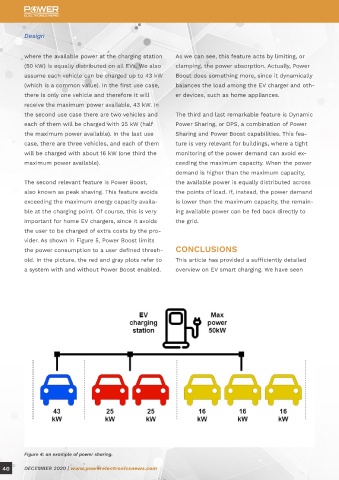
          where the available power at the charging station    As we can see, this feature acts by limiting, or

          (50 kW) is equally distributed on all EVs. We also   clamping, the power absorption. Actually, Power
          assume each vehicle can be charged up to 43 kW       Boost does something more, since it dynamically
          (which is a common value). In the first use case,    balances the load among the EV charger and oth-
          there is only one vehicle and therefore it will      er devices, such as home appliances.
          receive the maximum power available, 43 kW. In
          the second use case there are two vehicles and       The third and last remarkable feature is Dynamic
          each of them will be charged with 25 kW (half        Power Sharing, or DPS, a combination of Power
          the maximum power available). In the last use        Sharing and Power Boost capabilities. This fea-
          case, there are three vehicles, and each of them     ture is very relevant for buildings, where a tight

          will be charged with about 16 kW (one third the      monitoring of the power demand can avoid ex-
          maximum power available).                            ceeding the maximum capacity. When the power
                                                               demand is higher than the maximum capacity,
          The second relevant feature is Power Boost,          the available power is equally distributed across
          also known as peak shaving. This feature avoids      the points of load. If, instead, the power demand
          exceeding the maximum energy capacity availa-        is lower than the maximum capacity, the remain-
          ble at the charging point. Of course, this is very   ing available power can be fed back directly to

          important for home EV chargers, since it avoids      the grid.
          the user to be charged of extra costs by the pro-
          vider. As shown in Figure 5, Power Boost limits                                                                        Figure 5: the power boost feature.
          the power consumption to a user defined thresh-      CONCLUSIONS                                                       that Smart Charging is an intelligent and flexible    ▶   no need for heavy modifications to the exist-
          old. In the picture, the red and gray plots refer to   This article has provided a sufficiently detailed               technology able to stabilize networks, reduce            ing power network infrastructure.
          a system with and without Power Boost enabled.       overview on EV smart charging. We have seen                       costs and exploit renewable energy sources. The
                                                                                                                                 most valuable benefits arising from Smart Charg-     Safely balancing the energy usage between elec-
                                                                                                                                 ing implementation are:                              tric vehicle charging stations, as well as other
                                                                                                                                                                                      power demanding devices, ensures the most

                                                                                                                                  ▶   dynamic and flexible adjustment of EV charg-    efficient charging of EVs based on the available
                                                                                                                                     ing time and speed;                              power capacity.


                                                                                                                                  ▶   increased efficiency;


                                                                                                                                 For More Information


                                                                                                                                        ▶ GaN-based Dickson converter enhances Electric Vehicles efficiency


                                                                                                                                        ▶ Electric Vehicles: 48V is the new 12V

          Figure 4: an example of power sharing.

  40      DECEMBER 2020 | www.powerelectronicsnews.com                                                                                                                                  DECEMBER 2020 | www.powerelectronicsnews.com        41

