


Page 38 - Power Electronics News - December 2020
P. 38
Design                                                                                                                                                                                                               Design

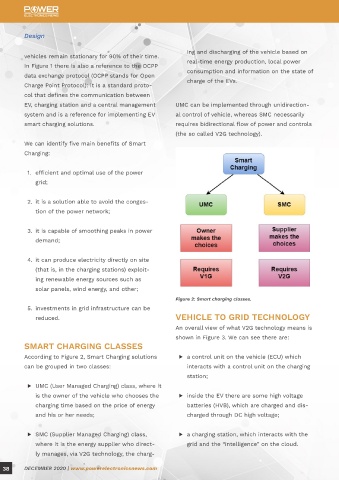
                                                                   ing and discharging of the vehicle based on
          vehicles remain stationary for 90% of their time.

          In Figure 1 there is also a reference to the OCPP        real-time energy production, local power
          data exchange protocol (OCPP stands for Open             consumption and information on the state of
          Charge Point Protocol): it is a standard proto-          charge of the EVs.
          col that defines the communication between
          EV, charging station and a central management        UMC can be implemented through unidirection-
          system and is a reference for implementing EV        al control of vehicle, whereas SMC necessarily
          smart charging solutions.                            requires bidirectional flow of power and controls
                                                               (the so called V2G technology).
          We can identify five main benefits of Smart

          Charging:


           1.  efficient and optimal use of the power
             grid;


           2.  it is a solution able to avoid the conges-
             tion of the power network;                                                                                          Figure 3: V2G block diagram.

                                                                                                                                 Actually, this picture refers to a more gener-       Power Sharing, also known as levelling or load
           3.  it is capable of smoothing peaks in power                                                                         al case, the so called V2X (Vehicle to Anything)     balancing. This feature allows power grid opera-
             demand;                                                                                                             technology, since both Vehicle to Grid and Vehi-     tors to distribute the available energy proportion-
                                                                                                                                 cle to Home are shown.                               ally (which means, equally) on all active charging
           4.  it can produce electricity directly on site                                                                                                                            stations. Therefore, Power Sharing allows an
             (that is, in the charging stations) exploit-                                                                                                                             optimal distribution of the available energy with-
             ing renewable energy sources such as                                                                                SMART CHARGING FEATURES                              out requiring any upgrade to the existing network
             solar panels, wind energy, and other;                                                                               The first important feature of Smart Charging is     infrastructure. Figure 4 shows three use cases

                                                               Figure 2: Smart charging classes.
           5.  investments in grid infrastructure can be
             reduced.                                          VEHICLE TO GRID TECHNOLOGY
                                                               An overall view of what V2G technology means is
                                                               shown in Figure 3. We can see there are:
          SMART CHARGING CLASSES

          According to Figure 2, Smart Charging solutions       ▶   a control unit on the vehicle (ECU) which
          can be grouped in two classes:                           interacts with a control unit on the charging

                                                                   station;
           ▶   UMC (User Managed Charging) class, where it
             is the owner of the vehicle who chooses the        ▶   inside the EV there are some high voltage
             charging time based on the price of energy            batteries (HVB), which are charged and dis-
             and his or her needs;                                 charged through DC high voltage;


           ▶   SMC (Supplier Managed Charging) class,           ▶   a charging station, which interacts with the
             where it is the energy supplier who direct-           grid and the “intelligence” on the cloud.
             ly manages, via V2G technology, the charg-


  38      DECEMBER 2020 | www.powerelectronicsnews.com                                                                                                                                  DECEMBER 2020 | www.powerelectronicsnews.com        39

