


Page 7 - EETEurope FlipBook February
P. 7
EE|Times EUROPE   7
                                                    Completely Autonomous Radar Sensor for Smart Motion Sensing


                                                                                         In addition, the sensor can be integrated
                                                                                       into systems such as laptops, tablets, TVs,
                                                                                       speakers, and thermostats to “wake” them
                                                                                       up based on motion or direction-of-motion
                                                                                       detection. It can also put devices to sleep or
                                                                                       into auto-lock when no motion is detected
                                                                                       for a defined amount of time to save energy,
                                                                                       increase lifetime, protect privacy, and
                                                                                       enhance the user experience overall.
                                                                                       USER-FRIENDLY AND LOW-POWER CHIP
                                                                                       Figure 4 shows the block diagram of the
                                                                                       BGT60LTR11AIP monolithic microwave
                                                                                       integrated circuit (MMIC). The integrated
                                                                                       voltage-controlled oscillator (VCO) generates
                                                                                       the high-frequency signal, which is stabilized
                                                                                       by a phase-locked loop. Moreover, the trans-
                                                                                       mitter section consists of a medium-power
                                                                                       amplifier with configurable output power. It
                                                                                       can be controlled via the serial peripheral
                                                                                       interface (SPI), while integrated power detec-
                                                                                       tors monitor the transmitted power.
                                                                                         The chip features a low-noise quadrature
                                                                                       receiver stage, wherein the receiver uses a
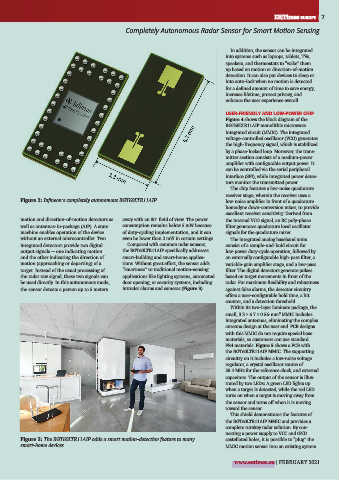
               Figure 2: Infineon’s completely autonomous BGT60LTR11AIP                low-noise amplifier in front of a quadrature
                                                                                       homodyne down-conversion mixer, to provide
                                                                                       excellent receiver sensitivity. Derived from
               motion and direction-of-motion detectors as   away with an 80° field of view. The power   the internal VCO signal, an RC poly-phase
               well as antennas-in-package (AIP). A state   consumption remains below 5 mW because   filter generates quadrature local oscillator
               machine enables operation of the device   of duty-cycling implementation, and it can   signals for the quadrature mixer.
               without an external microcontroller. Two   even be lower than 2 mW in certain settings.  The integrated analog baseband units
               integrated detectors provide two digital   Compared with common radar sensors,   consist of a sample-and-hold circuit for
               output signals — one indicating motion   the BGT60LTR11AIP specifically addresses   low-power duty-cycle operation, followed by
               and the other indicating the direction of   smart-building and smart-home applica-  an externally configurable high-pass filter, a
               motion (approaching or departing) of a   tions. Without great effort, the sensor adds   variable-gain amplifier stage, and a low-pass
               target. Instead of the usual processing of   “smartness” to traditional motion-sensing   filter. The digital detectors generate pulses
               the radar raw signal, these two signals can   applications like lighting systems, automated   based on target movements in front of the
               be used directly. In this autonomous mode,   door opening, or security systems, including   radar. For maximum flexibility and robustness
               the sensor detects a person up to 5 meters   intruder alarms and cameras (Figure 3).  against false alarms, the detector circuitry
                                                                                       offers a user-configurable hold time, a hit
                                                                                       counter, and a detection threshold.
                                                                                         Within its two-layer laminate package, the
                                                                                       small, 3.3 × 6.7 × 0.56-mm³ MMIC includes
                                                                                       integrated antennas, eliminating the complex
                                                                                       antenna design at the user end. PCB designs
                                                                                       with this MMIC do not require special base
                                                                                       materials, so customers can use standard
                                                                                       FR4 materials. Figure 5 shows a PCB with
                                                                                       the BGT60LTR11AIP MMIC. The supporting
                                                                                       circuitry on it includes a low-noise voltage
                                                                                       regulator, a crystal oscillator source of
                                                                                       38.4 MHz for the reference clock, and external
                                                                                       capacitors. The output of the sensor is illus-
                                                                                       trated by two LEDs: A green LED lights up
                                                                                       when a target is detected, while the red LED
                                                                                       turns on when a target is moving away from
                                                                                       the sensor and turns off when it is moving
                                                                                       toward the sensor.
                                                                                         This shield demonstrates the features of
                                                                                       the BGT60LTR11AIP MMIC and provides a
                                                                                       complete turnkey radar solution. By con-
                                                                                       necting a power supply to VCC and GND
               Figure 3: The BGT60LTR11AIP adds a smart motion-detection feature to many    castellated holes, it is possible to “plug” the
               smart-home devices.                                                     MMIC motion sensor into an existing system.


                                                                                          www.eetimes.eu | FEBRUARY 2021

