


Page 65 - EE Times Europe Magazine | February 2020
P. 65
EE|Times EUROPE   63


              IOT SENSORS AND MEMS
            Sensors Glue Virtual and Real Worlds,

            Says TDK InvenSense CTO


            By Anne-Françoise Pelé


                  he internet of things (IoT) is changing the way we interact with the world
                  around us. Everyone — and everything — is connected and soon will be
            T interconnected. Microelectromechanical systems (MEMS) devices and
            sensors assume an essential job in collecting, monitoring, and analyzing data,
            often in real time.
              In an interview with EE Times Europe, Peter Hartwell, CTO of TDK Inven-
            Sense, laid out a future in which IoT technologies transcend the individual
            experience and become invisible. It’s a future in which sensors are the glue
            between the virtual and the real worlds.
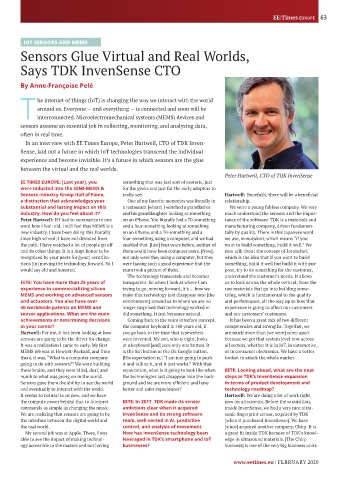
                                                                                    Peter Hartwell, CTO of TDK InvenSense
            EE TIMES EUROPE: [Last year], you   something that was just sort of esoteric, just
            were inducted into the SEMI-MEMS &   for the geeks and just for the early adopters to
            Sensors Industry Group Hall of Fame,   really see.                      Hartwell:  opefully, there will be a beneficial
            a distinction that acknowledges your   One of my favorite memories was literally in   relationship.
            substantial and lasting impact on this   a restaurant [where] I watched a grandfather   We were a young fabless company. We very
            industry. How do you feel about it?   and his granddaughter looking at something   much understood the sensors and the impor-
            Peter Hartwell: If I had to summarize in one   on an iPhone. You literally had a 70-something   tance of the software. TDK is a materials and
            word how I feel: old. I still feel that MEMS is a   and a four-something looking at something   manufacturing company, driven fundamen-
            new industry. I have been doing this literally   on an iPhone, and a 70-something and a   tally by quality. There is this Japanese word
            since high school; I have not deviated from   four-something using a computer, and we had   we use, monozukuri, which means “if you
            the path. I have watched a lot of people go off   enabled that. [Just] four years before, neither of   want to build something, build it well.” We
            and do other things. It is a huge honor to be   them would have been computer users. [Now],   now talk about the concept of kotozukuri,
            recognized by your peers for [your] contribu-  not only were they using a computer, but they   which is the idea that if you want to build
            tions [in] moving the technology forward. So I   were having such a good experience that the   something, build it well but build it with pur-
            would say old and honored.          mum took a picture of them.         pose, try to do something for the customer,
                                                  The technology transcends and becomes   understand the customer’s needs. It allows
            EETE: You have more than 25 years of   transparent. So when I look at where I am   us to look across the whole vertical, from the
            experience in commercializing silicon   trying to go, moving forward, it’s … how we   raw materials that go into building some-
            MEMS and working on advanced sensors   make that technology just disappear into [the   thing, which is fundamental to the quality
            and actuators. You also have over   environment] around us to where we are no   and performance, all the way up to how that
            40 worldwide patents on MEMS and    longer surprised that technology worked or   experience is going to affect our customers
            sensor applications. What are the main   did something. It just becomes natural.  and our customers’ customers.
            achievements or determining decisions   Coming back to the voice interface concept,   It has been a great mix of two different
            in your career?                     the computer keyboard is 140 years old, if   competencies and strengths. Together, we
            Hartwell: For me, it has been looking at how   you go back to the time that typewriters   are much more than [we were] when apart
            sensors are going to be the driver for change.   were invented. My son, who is eight, looks   because we get that system level now across
            It was a realization I came to early. My first   at a keyboard [and] sees only one button. It   all sectors, whether it is in IoT, in automotive,
            MEMS job was at Hewlett-Packard, and from   is the Siri button or the Ok Google button.   or in consumer electronics. We have a better
            there, it was, “What is a computer company   [His expectation is,] “I am just going to push   toolset to attack the whole market.
            going to do with sensors?” We were building   it and talk to it, and it just works.” With that
            these brains, and they were blind, deaf, and   expectation, what is it going to look like when   EETE: Looking ahead, what are the next
            numb to what was going on in the world.   the technologies just disappear into the back-  steps in TDK’s InvenSense expansion
            Sensors gave them the ability to see the world   ground and we are more efficient and have   in terms of product development and
            and eventually to interact with the world.   better and safer experiences?  technology roadmap?
            It seems so natural to us now, and we have                              Hartwell: We are doing a lot of work right
            the compute power behind that to interpret   EETE: In 2017, TDK made its sensor   now on ultrasonics. Before the acquisition,
            commands as simple as changing the music.   ambitions clear when it acquired   inside InvenSense, we had a very nice ultra-
            We are realizing that sensors are going to be   InvenSense and its strong software   sonic fingerprint sensor, acquired by TDK
            the interface between the digital world and   team, well-versed in AI, predictive   [when it purchased InvenSense]. We have
            the real world.                     control, and analysis of movement.   [since] acquired another company, Chirp. It is
              My second job was at Apple. There, I was   How has InvenSense technology been   a great fit inside TDK because of TDK’s knowl-
            able to see the impact of making technol-  leveraged in TDK’s smartphone and IoT   edge in ultrasound materials. [The Chirp
            ogy accessible to the masses and not having   businesses?               business] is one of the very big business units

                                                                                       www.eetimes.eu | FEBRUARY 2020

