


Page 64 - EE Times Europe Magazine | February 2020
P. 64
62 EE|Times EUROPE


            OPINION

            What’s the Best Strategy


            for AI Regulation?


            By Sally Ward-Foxton


                                During CES, the White House issued a draft memo to U.S. govern-
                                ment agencies with guidance on creating regulations for the use of
                                artificial-intelligence technology in the private sector. The memo,
                                from the White  ouse Office of Science and Technology Policy
                                (OSTP), was intended both to promote the trustworthy use of AI
                                technology and help avoid its overregulation.         Preventing authoritarian use of AI
                                  Are those two goals at odds                         depends on becoming a global leader in
                                  The White  ouse thinks not. Its position is that the way to become   the technology. (Image: Scott Webb/Pexels)
                                a global leader in AI is to avoid unnecessary regulation, and the best
            way to ensure ethical use of the technology is to be a global leader in it.
              Indeed, the White  ouse went as far as to warn Europe in strong terms not to overregulate.  As the White House warns
              “Europe and our allies should avoid heavy-handed innovation-killing models,” reads a
            statement issued by the OSTP. “The best way to counter authoritarian uses of AI is to make sure   Europe against overregulation,
            America and our international partners remain the global hubs of innovation, shaping the evolu-
            tion of technology in a manner consistent with our common values.”      is ethical use of AI necessarily
              Europe’s approach to AI regulation is not yet set in stone, but all the signs point toward strin-  an innovation killer?
            gent legislation — the opposite of the approach favored by the U.S.
              European Commission president Ursula von der Leyen set the tone when she made the human
            and ethical implications of AI a cornerstone of her pre-election manifesto, promising to put   the public is essential to the development of a
            forward legislation for a coordinated European approach.                sustainable AI industry and, by extension, the
              A recent report by Germany’s Data Ethics Commission recommended tough new rules for AI   evolution of AI technology.
            ethics, with strong measures taken against “ethically indefensible uses of data.” This was widely   Public trust is not something to gamble
            seen as an indication that any new EU rules on AI uses would be just as tough, given that a previ-  with — once it’s lost, it’s gone forever — so
            ous report from the Data Ethics Commission was the basis for the EU’s General Data Protection   regulation is needed to maintain it. GDPR has
            Regulation (GDPR).                                                      been widely copied, from  apan to Brazil. If it
                                                                                    plays its hand wisely, Europe could once again
            TO REGULATE OR NOT TO REGULATE?                                         lead the world in this area.
            It’s clear that regulation will play a key role in shaping the emerging landscape as global super-  Proving that ethical use of AI is not neces-
            powers jostle to gain expertise in this game-changing technology. But which strategy is better,   sarily an innovation killer will be hard, but it
            and what is the right balance between regulation and innovation         is not worth compromising over. ■
              Is regulation required to prevent the authoritarian use of AI — already an alarming trend for
            applications such as facial recognition in some countries  My gut says that the industry cannot   Sally Ward-Foxton is a staff correspondent
            be expected to police itself on issues as critical as civil liberties. Ultimately, earning the trust of   at AspenCore.


                                                                                                                       IMAGES  S UTTERSTOCK


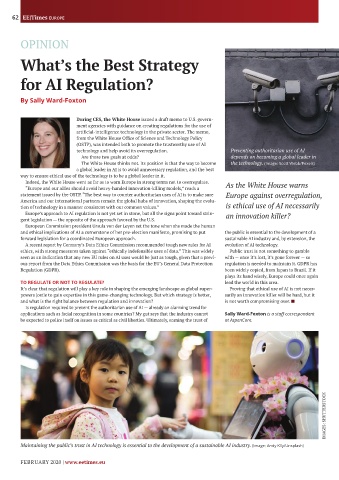
            Maintaining the public’s trust in AI technology is essential to the development of a sustainable AI industry. (Image: Andy Klly/Unsplash)

            FEBRUARY 2020 | www.eetimes.eu

