


Page 35 - EE Times Europe Magazine | February 2020
P. 35
EE|Times EUROPE   33


              TTA AT CES
            Taiwan Tech Arena Takes Record  2 Startups

            to CES 2020


            By Nitin Dahad


                 or the third year in a row, Taiwan had a significant
                 presence at one of the biggest electronics trade
                 fairs in the world  CES 2020. A delegation of  2
           F startups, led by the Taiwan Tech Arena (TTA), came
            to Las  egas to present technologies and scout investment
            partners. It was TTA’s largest delegation to date, and col-
            lectively, the startups signed more than US$226 million in
            business opportunities, the trade group said.
              “We have  2 startup teams covering three areas
            artificial intelligence, smart technologies, and health
            care,” Yu-Chin  su, deputy minister for Taiwan’s Ministry
            of Science and Technology, told EE Times Europe in an
            interview at CES.  su emphasized the need for Taiwan and
            its startups to be connected to the global tech ecosystem
            in all key markets and applications, which is why an inter-
            national trade fair like CES is a valuable platform for these
            companies. “We  believe  that in the future in the AI age,
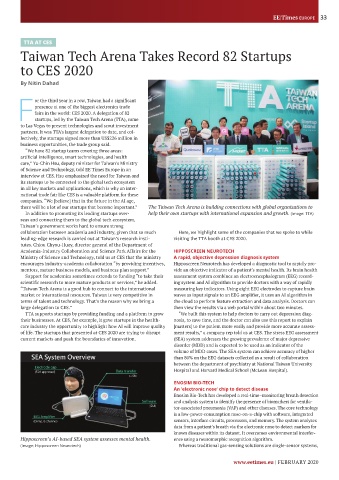
            there will be a lot of our startups that become important.”  The Taiwan Tech Arena is building connections with global organizations to
              In addition to promoting its leading startups over-  help their own startups with international expansion and growth. (Image: TTA)
            seas and connecting them to the global tech ecosystem,
            Taiwan’s government works hard to ensure strong
            collaboration between academia and industry, given that so much    ere, we highlight some of the companies that we spoke to while
            leading-edge research is carried out at Taiwan’s research insti-  visiting the TTA booth at CES 2020.
            tutes. Chiou Chyou- uey, director general of the Department of
            Academia-Industry Collaboration and Science Park Affairs for the   HIPPOSCREEN NEUROTECH
            Ministry of Science and Technology, told us at CES that the ministry   A rapid, objective depression diagnosis system
            encourages industry-academia collaboration “by providing incentives,    ipposcreen Neurotech has developed a diagnostic tool to rapidly pro-
            mentors, mature business models, and business plan support.”  vide an objective indicator of a patient’s mental health. Its brain health
              Support for academics sometimes extends to funding “to take their   assessment system combines an electroencephalogram (EEG) record-
            scientific research to more mature products or services,” he added.   ing system and AI algorithm to provide doctors with a way of rapidly
            “Taiwan Tech Arena is a good hub to connect to the international   measuring key indicators. Using eight EEG electrodes to capture brain
            market or international resources. Taiwan is very competitive in   waves as input signals to an EEG amplifier, it uses an AI algorithm in
            terms of talent and technology. That’s the reason why we bring a   the cloud to perform feature extraction and data analysis. Doctors can
            large delegation to CES.”                             then view the results via a web portal within about two minutes.
              TTA supports startups by providing funding and a platform to grow   “We built this system to help doctors to carry out depression diag-
            their businesses. At CES, for example, it gave startups in the health-  nosis, to save time, and the doctor can also use this report to explain
            care industry the opportunity to highlight how AI will improve quality    matters  to the patient more easily and provide more accurate assess-
            of life. The startups that presented at CES 2020 are trying to disrupt   ment results,” a company rep told us at CES. The stress EEG assessment
            current markets and push the boundaries of innovation.   (SEA) system addresses the growing prevalence of major depressive
                                                                  disorder (MDD) and is expected to be used as an indicator of the
                                                                  volume of MDD cases. The SEA system can achieve accuracy of higher
                                                                  than  0  on the EEG datasets collected as a result of collaboration
                                                                  between the department of psychiatry at National Taiwan University
                                                                   ospital and  arvard Medical School (McLean  ospital).

                                                                  ENOSIM BIO-TECH
                                                                  An ‘electronic nose’ chip to detect disease
                                                                  Enosim Bio-Tech has developed a real-time monitoring breath detection
                                                                  and analysis system to identify the presence of biomarkers for ventila-
                                                                  tor-associated pneumonia ( AP) and other diseases. The core technology
                                                                  is a low-power-consumption nose-on-a-chip with software, integrated
                                                                  sensors, interface circuits, processors, and memory. The system analyzes
                                                                  data from a patient’s breath via the electronic nose to detect markers for
                                                                  known diseases within its dataset. It overcomes environmental interfer-
            Hipposcreen’s AI-based SEA system assesses mental health.    ence using a neuromorphic recognition algorithm.
            (Image: Hipposcreen Neurotech)                          Whereas traditional gas-sensing solutions are single-sensor systems,

                                                                                       www.eetimes.eu | FEBRUARY 2020

